20th century

South Chancel Window - Wolston Warwickshire

South Chancel Window - Wolston Warwickshire

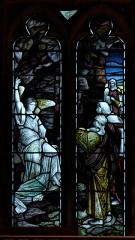
This south chancel window at Wolston, designed by Herbert Bryans , is a two-light composition dated by inscription to 1902 and belongs to Bryans’s early independent period following his departure from the Kempe studio.

Description and iconography

The upper lights present two standing figures beneath tall Gothic canopies, arranged as a typological pairing concerned with prophecy and fulfilment.
Taunton, Donald Battershill

Active: 1910–1964
Taunton, Donald Battershill

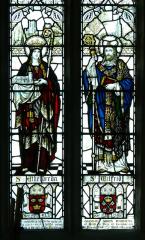
Donald Battershill Taunton was one of the most influential stained-glass designers associated with Hardman & Co in the mid-20th century, serving as the firm’s chief designer from 1935 until his retirement in 1964. Following the retirement of John Tarleton Hardman in 1936, Taunton assumed joint responsibility for the running of the firm alongside Patrick Feeny, Tom Farrell, and Vincent Durk, guiding Hardman’s through a period of stylistic consolidation and institutional continuity.

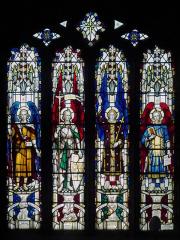
The Four Archangels - Stamford, Lincolnshire

The Four Archangels - Stamford, Lincolnshire

This four-light stained-glass window, dated 1935 and executed by A. K. Nicholson, depicts the four archangels — Saint Raphael, Saint Michael, Saint Gabriel, and Saint Uriel — each standing beneath high Gothic canopies and identified by traditional attributes and associated predella figures.

From left to right:

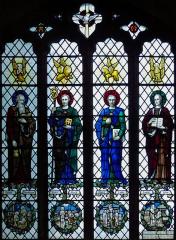
The Four Evangelists - Stamford, Lincolnshire

The Four Evangelists - Stamford, Lincolnshire

This four-light stained-glass window, at All Saints Stamford, dated 1931 and signed by Archibald Keightley Nicholson, depicts the Four Evangelists accompanied by their traditional symbols and narrative predella scenes.

From left to right:

  • Saint Matthew , holding a book, with the winged man (or angel) above him.

  • Saint Mark, holding a book and key, with the winged lion above.

  • Saint Luke , bearing the Gospel, surmounted by the winged ox.

  • Saint John , youthful and contemplative, with the eagle above.

The Millennium Windows at Orléans Cathedral

The Millennium Windows at Orléans Cathedral

Pierre Carron’s Millennium Windows at Orléans Cathedral stand as luminous meditations on creation, light, and faith renewed at the turn of the twenty-first century. Set within the soaring Gothic tracery of the cathedral, they bridge centuries of sacred art by merging medieval structure with a modern painter’s vision.

The Sower - Radway, Warwickshire

The Sower - Radway, Warwickshire

This south aisle window depicts the Parable of the Sower, interpreted with restraint and symbolic clarity by Arild Rosenkrantz, one of the most distinctive figures in early twentieth-century stained glass.

The Stained Glass Cycle at Déols

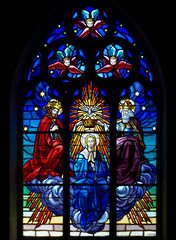
Coronation of the Virgin

Between 1929 and 1932 the Parisian atelier Mauméjean Frères created a vivid sequence of stained-glass windows for the church of Notre-Dame, Déols. The cycle traces key moments in the lives of the Virgin Mary and Christ, from the Nativity and Annunciation through the Visitation and the miracle at Cana, and finally to the Crucifixion, Resurrection, and the heavenly Coronation of the Virgin.

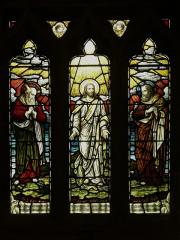
The Transfiguration - Ladbroke Warwickshire

The Transfiguration - Ladbroke Warwickshire

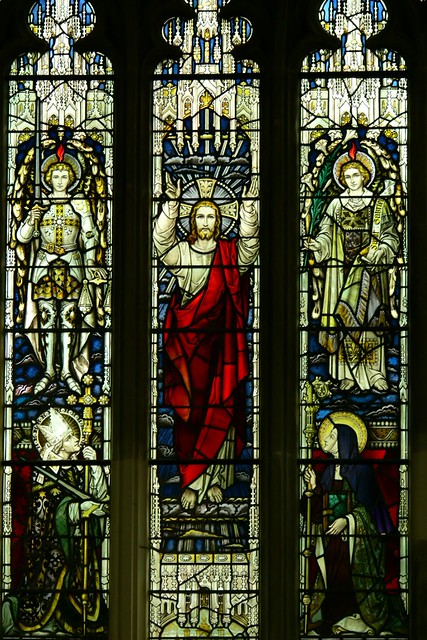
This three-light window (1906-1910) depicts the Transfiguration of Christ on Mount Tabor, a subject rendered with characteristic clarity and luminosity by John Hardman & Co. Christ stands in the central light, enveloped in rays of golden light and dressed in shining white garments. The rocky ground beneath him and the stylised clouds behind create the sense of elevation associated with the biblical account.

Three Marys at the Tomb - Litchborough Northamptonshire

Three Marys at the Tomb - Litchborough Northamptonshire

This two-light stained-glass window depicting the Three Marys at the Tomb, dated 1917, is attributable to Burlison & Grylls and belongs to the firm’s late ecclesiastical output during the First World War period.

Description and iconography

The composition presents the moment immediately following the Resurrection, as described in the Gospels, when the holy women come to the tomb and receive the angelic announcement that Christ has risen.

Pages

Subscribe to 20th century