
Taunton, Donald Battershill
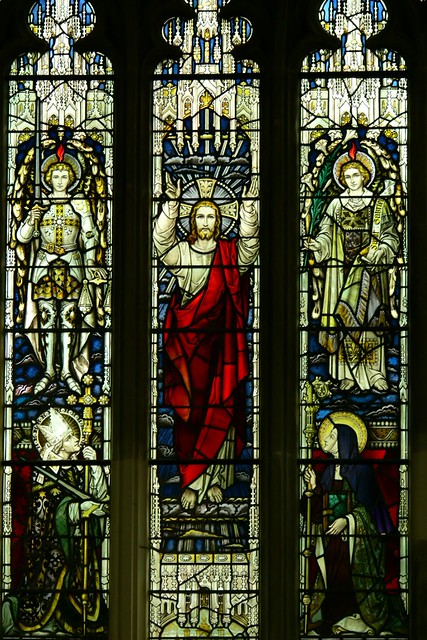
Donald Battershill Taunton was one of the most influential stained-glass designers associated with Hardman & Co in the mid-20th century, serving as the firm’s chief designer from 1935 until his retirement in 1964. Following the retirement of John Tarleton Hardman in 1936, Taunton assumed joint responsibility for the running of the firm alongside Patrick Feeny, Tom Farrell, and Vincent Durk, guiding Hardman’s through a period of stylistic consolidation and institutional continuity. His precise entry into professional practice is undocumented, but his education and later seniority at Hardman & Co indicate that he was active by the 1910s
Training and background
Unlike many designers within the Hardman studio, whose formation was shaped by a conventional Catholic education and devotional culture, Taunton followed a more secular and academically grounded path. He was educated at Saltley College School in Birmingham before training at the Birmingham School of Art, an institution strongly associated with Arts and Crafts ideals and disciplined draughtsmanship.
This background gave Taunton a solid grounding in figure drawing, composition, and decorative design, rather than the liturgical or iconographic training typical of earlier Hardman designers. As a result, his work is often characterised by clarity of line, structural balance, and restraint rather than overtly emotive or revivalist tendencies.
Role at Hardman & Co
Taunton’s appointment as chief designer in 1935 coincided with the firm’s need to maintain its long-established reputation while adapting to changing ecclesiastical tastes and economic conditions between the inter-war years and the post-war period. Under his leadership, Hardman’s continued to supply stained glass for cathedrals, parish churches, and commemorative schemes across Britain and the wider Anglican and Catholic world.
As a designer-administrator, Taunton played a key role in:
-
Overseeing iconographic programmes for large multi-light windows
-
Ensuring consistency of style across collaborative studio production
-
Balancing traditional Gothic revival forms with simplified, modernised compositions
-
Maintaining Hardman’s historic visual identity during a period of artistic transition
His long tenure brought a notable stylistic stability to the firm at a time when many stained-glass studios were fragmenting or closing.
Style and artistic character
Taunton’s stained glass is typically marked by:
-
Clear, legible figure design with calm, composed poses
-
Strong linear drawing, reflecting academic art-school training
-
Restrained but harmonious colour palettes, avoiding excessive brilliance
-
Drapery treated with controlled folds rather than dramatic movement
-
A preference for balanced architectural integration over pictorial complexity
While firmly rooted in the Gothic revival tradition that defined Hardman’s output, Taunton’s work often shows a quiet modern sensibility, particularly in later windows, where forms are simplified and narrative clarity is prioritised over surface ornament.
Assessment and legacy
Donald Battershill Taunton’s importance lies less in radical innovation than in stewardship and continuity. As chief designer and joint director, he ensured that Hardman & Co remained a reliable and respected producer of ecclesiastical stained glass well into the mid-20th century. His work represents the last mature phase of the Hardman tradition, bridging Victorian and Edwardian inheritance with the changing artistic climate of the post-war church.
Although individual windows are rarely signed or attributed exclusively to him, Taunton’s hand is evident across many Hardman commissions of the period, making him a central—if understated—figure in the history of British stained glass.
