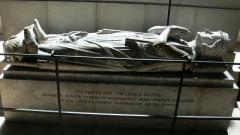
Henry II of England Tomb- Fontevraud Abbey, France
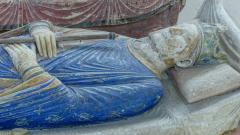
Tomb of King Henry II of England ⓘ at Fontevraud Abbey, France.
Tomb of King Henry II of England ⓘ at Fontevraud Abbey, France.
Tomb of Henry the Young King (d1183) son of Henry II of England ⓘ and Eleanor of Aquitaine ⓘ, brother of King Richard I of England ⓘ and King John.
John of England ⓘ, the youngest son of Henry II ⓘ and Eleanor of Aquitaine ⓘ, became king of England in 1199 following the death of his brother Richard I of England ⓘ. His accession was immediately contested by his nephew Arthur of Brittany, whose claim was supported by Philip II of France ⓘ. The resulting struggle marked the beginning of John’s loss of much of the Angevin empire in France and exposed the structural fragility of a dominion already strained by the financial and military demands of Richard’s reign.
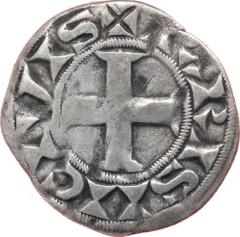
Louis VII was king of France during a formative period in the consolidation of Capetian royal authority. Ascending the throne in 1137, he inherited a kingdom whose effective power rested as much on dynastic alliances and ecclesiastical support as on territorial control. His reign was marked by deep personal piety, close engagement with the Church, and sustained political rivalry with the Angevin rulers of England.

The south porch of Chartres Cathedral contains a series of sculptures, that were made between 1194 and 1230, on the subject of the martyrdom of saints.
The south side of the choir clerestory ⓘ at Bourges Cathedral contains a remarkably complete early-Gothic cycle of New Testament figures, created between about 1200 and 1225. These tall, independent lancets depict apostles and evangelists in a unified iconographic programme, forming a deliberate counterpart to the Old Testament prophets on the north side of the choir.
The only New Testament figures not on the south side are those in the apex window, w.200 - the Virgin and Child with St Stephen ⓘ — which stand on the north side and serve a special liturgical and dedicatory function.
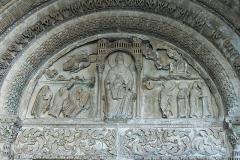
The north portal of Bourges Cathedral is dedicated to the Virgin Mary ⓘ. The Tympanum ⓘ dates from between 1160 and was part of the older church the the Gothic cathedral replaced. This portal suffered a lot of damage during the Wars of Religion in 1562.
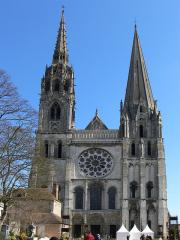
Designated a World heritage Site by UNESCO in 1979 the Cathedral of Notre-Dame de Chartres was built from between 1145 and 1250. It's high nave is spanned by ogival pointed arches to form the vault, and the walls are supported by double flying buttresses. Chartres is the first building to have used buttresses as a structural element.
Chartres Cathedral is also unique in having retained almost all of its original 12th and 13th century stained glass.
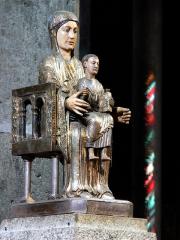
In form and iconography, the statue is closely modelled on the celebrated “Golden Virgin” commissioned by the Bishop of Clermont in 946, a cult image that was destroyed during the Revolution when it was melted down for coinage. On stylistic and material grounds, the Orcival Virgin is now dated to c. 1170, making it a later but faithful reinterpretation of the earlier episcopal image.
Following the death of Pope Adrian IV, Rolando of Siena was elected pope as Alexander III on 7 September 1159. His election immediately plunged the Church into schism: on the same day, Cardinal Ottaviano de' Monticelli was proclaimed antipope Victor IV. Each excommunicated the other, but Victor’s authority was confined largely to territories controlled by the Holy Roman Emperor Frederick I, whose support transformed the schism into a prolonged contest between papal independence and imperial power.