12th century

Archbishop Anselm of Canterbury

Anselm of Canterbury was one of the most influential churchmen and theologians of the late 11th and early 12th centuries, whose archiepiscopate was shaped by repeated conflict with royal authority over the independence of the Church. Appointed Archbishop of Canterbury in 1093, Anselm soon found himself at odds with King William II of England (William Rufus), particularly over the appointment of bishops, the demand that Anselm perform homage to the king, and royal interference in ecclesiastical affairs.
Archbishop Thomas Becket of Canterbury

Thomas Becket was one of the most powerful and controversial ecclesiastical figures of the twelfth century. His career illustrates the tensions between royal authority and the autonomy of the Church in Angevin England, while his death transformed him from royal servant and archbishop into an international martyr and focus of pilgrimage.

Bernard of Clairvaux

Bernard of Clairvaux was a Cistercian abbot, reformer, preacher, and theologian whose influence shaped twelfth-century Europe spiritually, politically, and intellectually. Born near Dijon into a Burgundian noble family, he entered the Cistercian monastery of Cîteaux in 1112 and soon became the founding abbot of Clairvaux (1115), one of the most important daughter houses of the order.

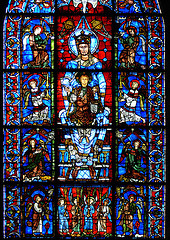
Blue Virgin


Set into a 13th century window, in the south ambulatory of the choir (bay 44) of Chartres Cathedral, this is one of the most celebrated medieval artworks in the Cathédrale Notre-Dame de Chartres.It dates primarily to c. 1180 CE, with later additions around 1225 CE, making it a rare survivor from the pre-1194 fire that destroyed the earlier Romanesque cathedral.


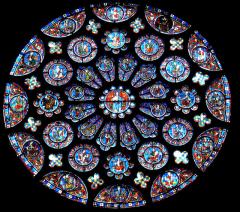
Chartres Cathedral

Chartres Cathedral

Chartres Cathedral has some of the most beautiful medieval stained glass windows to have survive the upheavals of the last 800 years. The earliest date from the mid 12th century, but most are from the 13th century.


Confessors - Chartres Cathedral


In addition to the martyrs, the south porch contains a sequence of images of those that had proclaimed Christian beliefs during periods of suppression (confessors).

Crucifixion - Saint Albans Cathedral

Crucifixion - Saint Albans Cathedral

This late twelfth-century mural of the Crucifixion survives on the south-west nave pier of St Albans Cathedral. Executed in a restrained Romanesque manner, the composition presents Christ crucified between the Virgin Mary and St John the Evangelist .

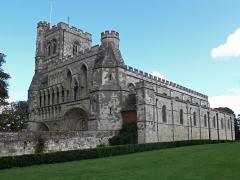
Dunstable Priory

Dunstable Priory

Dunstable Priory, formally the Priory Church of St Peter , was founded c. 1131–1132 by Henry I as a house of Augustinian Canons. Strategically sited at the intersection of two major ancient routes—Watling Street and the Icknield Way—the priory occupied a key position within England’s medieval road network, a factor that profoundly shaped both its prosperity and the development of the surrounding town.

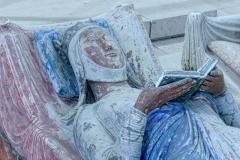
Eleanor of Aquitaine

Eleanor of Aquitaine

Born around 1122, Eleanor of Aquitaine was one of the most powerful women of the medieval world. Duchess of Aquitaine in her own right, she became queen consort of two great monarchs in succession, first as the wife of Louis VII of France , whom she married in 1137, and later as queen of England through her marriage to Henry of Anjou in 1152. Through these unions, Eleanor stood at the centre of the political and dynastic networks linking France and England in the 12th century.

Frederick I Barbarossa

Frederick I, known as Barbarossa (“Red Beard”), was King of the Romans from 1152 and Holy Roman Emperor from 1155 until his death in 1190. A member of the Hohenstaufen dynasty, he sought to restore imperial authority in Germany and Italy, reasserting claims of sovereignty over territories that had developed strong communal and episcopal autonomy.

Pages

Subscribe to 12th century