
Morris & Co.
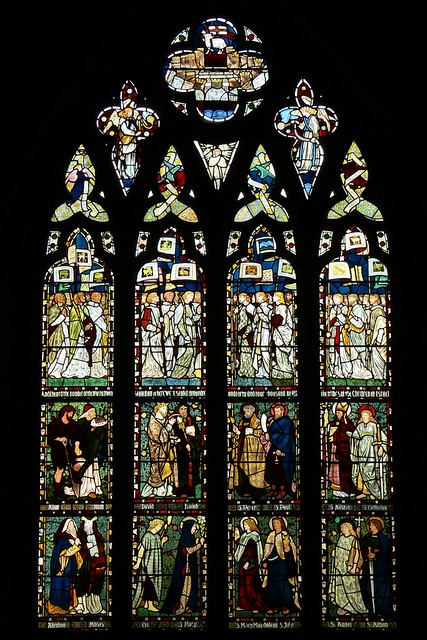
Founded in 1861 as Morris, Marshall, Faulkner & Company, the firm was established by the socialist artist, designer, and writer William Morris as a retailer and workshop for decorative arts and furnishings. From the outset, the company was conceived as a collaborative enterprise, bringing together artists and designers who shared a commitment to the revival of traditional craftsmanship and a rejection of industrialised mass production.
In 1875 the firm was reorganised as Morris & Co, with Morris as its sole proprietor, though the intellectual and artistic foundations continued to rest on the work of its original circle. Among those closely associated with the company were Ford Madox Brown, Dante Gabriel Rossetti, Peter Paul Marshall, Philip Webb, Charles James Faulkner, and Edward Burne-Jones ⓘ, figures central to the Pre-Raphaelite circle and its wider influence on Victorian art and design.
The firm initially concentrated on ecclesiastical decoration, particularly stained glass, mural painting, and architectural carving. Early production was based in Red Lion Square, London, before a move in 1865 to larger premises at Queen Square, Bloomsbury. Church decoration remained a core activity, and Morris & Co. rapidly became one of the most important suppliers of stained glass to Anglican churches in Britain and abroad.
Over time, the scope of the firm expanded considerably. Morris & Co. designed and manufactured furniture, metalwork, and glasswares, as well as textiles of many kinds, including printed cottons, woven and knotted carpets, silk damasks, embroideries, tapestries, and paper wall-hangings. Jewellery and other decorative objects also formed part of its output. Across all media, the firm emphasised hand workmanship, natural materials, and designs derived from medieval, Renaissance, and vernacular sources.
The medieval-inspired aesthetic promoted by Morris & Co., together with its respect for traditional craft techniques, had a profound and lasting influence on the decoration of churches and domestic interiors. Its principles shaped the development of the Arts and Crafts Movement and continued to inform architectural and decorative practice well into the early twentieth century, in Britain and beyond.
