Denny, Thomas
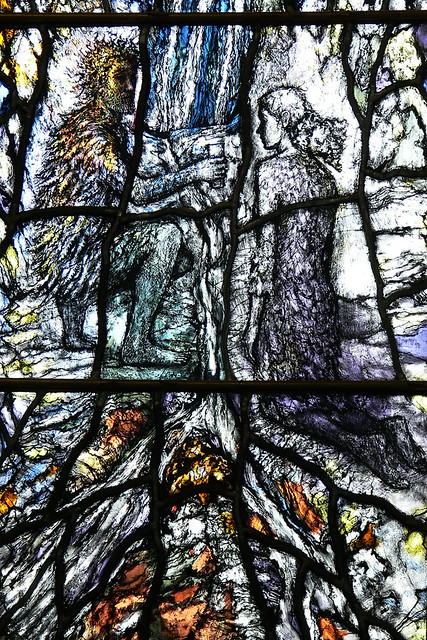
Tom Denny is one of the leading contemporary British stained-glass artists, renowned for a highly personal and painterly approach to light, colour, and surface. His work combines a deep engagement with medieval stained-glass techniques and iconography with a distinctly modern sensibility, characterised by atmospheric colour, abstraction, and an acute response to architectural and landscape setting.
Born in London in 1956, he is the son of Sir Anthony Denny, 8th Baronet of Tralee Castle, and Catherine Beverley. He was educated at King Alfred’s School, Hampstead, before training as a painter at the Edinburgh College of Art. Although his early formation was in easel painting, Denny increasingly turned towards stained glass, finding in the medium a means of exploring light, texture, and narrative on an architectural scale.
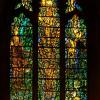
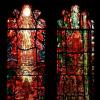
Denny’s stained-glass practice is notable for its extensive and sophisticated use of traditional techniques, particularly acid-etched flashed glass and silver stain, employed to create richly worked surfaces and subtle tonal transitions. Rather than relying on strong linear definition, his windows often dissolve form into colour and light, producing images that emerge gradually as the eye adjusts. This approach gives his work a contemplative, immersive quality, well suited to liturgical and devotional spaces.
Landscape, scripture, and the specific character of place are central to Denny’s work. Biblical narratives are frequently re-imagined through natural imagery, trees, water, stone, sky, allowing the theological content to be conveyed through atmosphere as much as figuration. His windows are carefully calibrated to their architectural context, responding to scale, orientation, and the changing qualities of daylight.
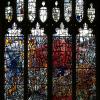
Denny has received numerous major commissions for churches and cathedrals throughout Britain. His work can be seen in prominent settings including Hereford Cathedral, Gloucester Cathedral, Leicester Cathedral, and many parish churches, where his windows often form part of larger iconographic or architectural programmes.