
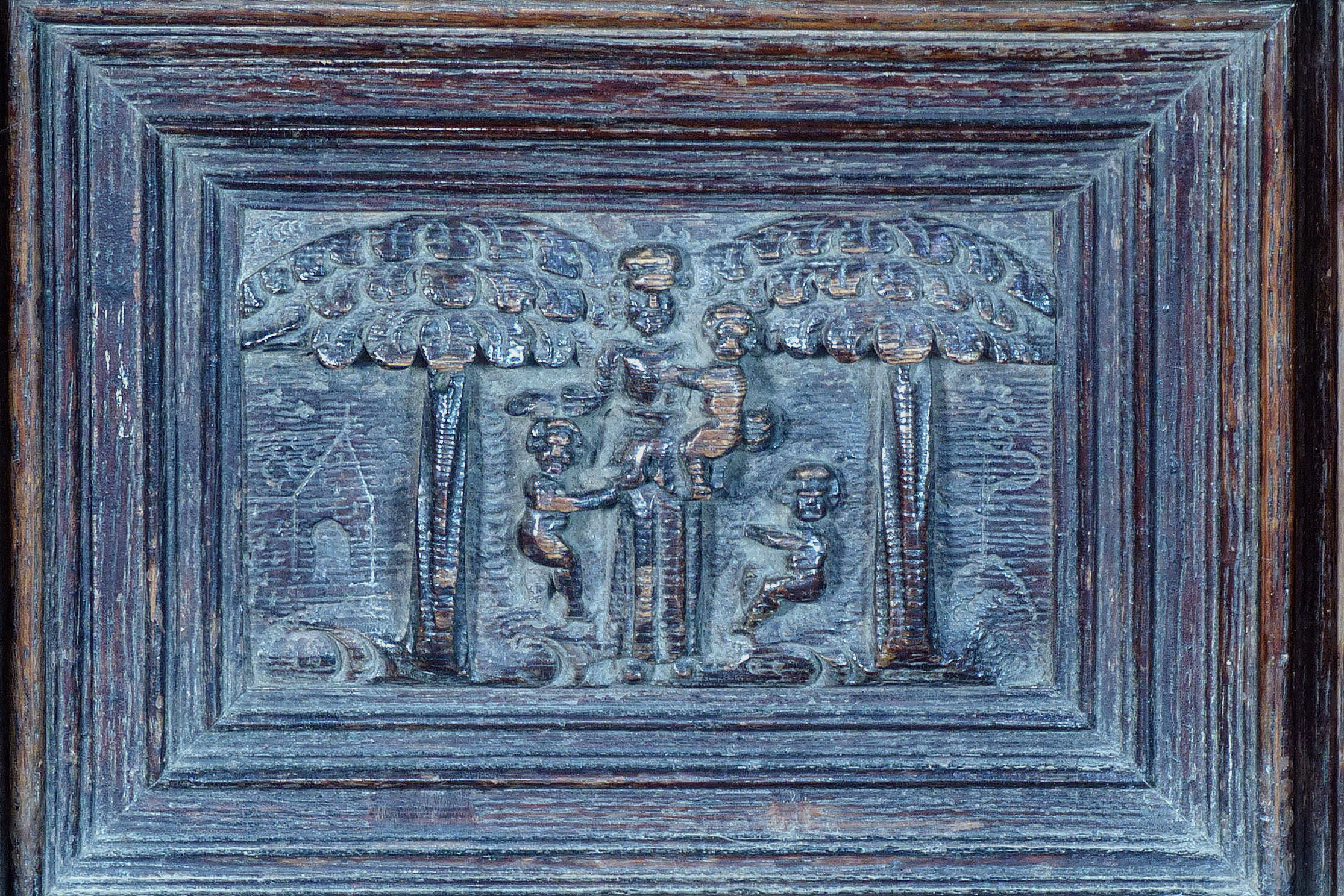
This carved pew-end panel, from Thenford, Northamptonshire, dates to the late sixteenth or early seventeenth century (c.1580–1625) and belongs to the tradition of figurative church woodwork produced in England after the Reformation. Executed in shallow relief and enclosed within a moulded rectangular frame, the panel presents a compact and emblematic sacred image rather than a narrative scene.
At the centre stands a female figure holding a child, both shown frontally and identified by halos. The scale, posture, and grouping support an identification as the Virgin and Child, expressed without explicit devotional attributes and in a restrained manner appropriate to the post-Reformation context.
Flanking the central figures are two smaller haloed attendants, one on either side, shown in deferential or protective postures. One appears to kneel or descend, while the other reaches toward the Virgin’s garment. Their halos indicate sanctity, and they are best understood as angelic figures or possibly unnamed saints, included to frame and support the central group rather than to enact a specific biblical episode.
The composition is enclosed by two stylised trees, which serve to structure the scene and create an enclosed sacred space without functioning as a narrative setting. The imagery is emblematic and hierarchical, emphasising protection, mediation, and sanctity rather than action or drama.
Such imagery reflects the continued, carefully controlled use of Marian themes in English parish churches after the Reformation. Presented as a theological symbol rather than an object of devotion, the Virgin and Child remain central, supported by attendant figures whose role is visual and doctrinal rather than intercessory.
As sculpture, the panel belongs to the same tradition as late medieval and early post-medieval choir-stall, misericord, and pew-end carving, adapted to the altered religious climate of the late sixteenth and early seventeenth centuries. Its survival offers rare evidence of how figurative sacred imagery persisted in English church woodwork in a restrained and emblematic form.
