
Cleansing the Temple Polychrome Relief - Amiens Cathedral
This richly animated cycle of polychrome reliefs depicts the episode of Christ Cleansing the Temple (Matthew 21:12–13; Mark 11:15–17; Luke 19:45–46; John 2:13–16). Carved in deep relief and originally conceived as a continuous narrative sequence, the scenes unfold across the west wall of the north transept, drawing the viewer into the crowded precincts of the Temple in Jerusalem.
Christ appears centrally within the architectural setting of the Temple court, confronting those who have transformed a sacred space into a place of commerce. His commanding gesture and forward-leaning stance contrast sharply with the startled, defensive reactions of the surrounding figures, whose agitated poses and expressive faces convey disorder, confusion, and moral disarray.
Iconography and Narrative Structure
The ensemble is structured as a multi-scene narrative rather than a single frozen moment:


-
Christ among the traders
Christ stands before the traders and officials of the Temple square, his raised arm and open mouth suggesting speech or rebuke rather than physical violence. This accords closely with late medieval exegetical traditions that emphasised Christ’s authority of word and presence as much as his action.

-
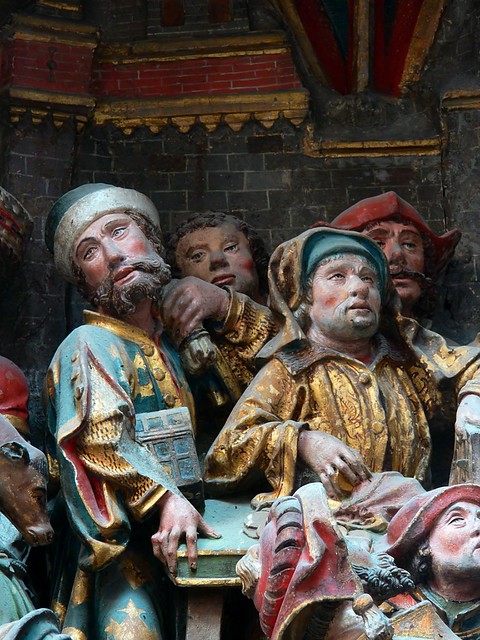
Money-changers and merchants
The figures traditionally labelled “moneylenders” are more precisely understood as money-changers (cambistes), responsible for exchanging diverse regional coinage into acceptable Temple currency. Pilgrims arriving from across Judaea and the wider Mediterranean would also purchase sacrificial animals on site. The sculptors carefully differentiate social types through costume, headgear, and gesture, presenting a cross-section of urban life rather than a caricature of greed alone.


-
The Twelve Loaves
A striking relief shows the twelve loaves, representing the Bread of the Presence (lechem ha-panim), set out before the Lord as symbols of the Twelve Tribes of Israel. Their inclusion anchors the scene firmly within Old Testament ritual practice and reinforces the theological argument that Christ is purifying, not abolishing, the Temple.


-
The High Priest and the Ark
In a related scene, the High Priest censes the Ark of the Covenant, an explicitly cultic image that situates Christ’s actions within the continuum of sacred history. This juxtaposition underscores the contrast between divinely ordained ritual and its corruption through commercial intrusion.
Style and Technique
Carved in the early sixteenth century, the reliefs exhibit hallmarks of late Gothic sculpture transitioning toward Renaissance naturalism:
-
dense crowding of figures within architectural frames
-
animated drapery with broken, angular folds
-
strongly individualized physiognomies
-
vivid polychromy, originally far more intense than today
The sculptors exploit depth aggressively, with figures projecting outward into the viewer’s space, enhancing the dramatic immediacy of the confrontation.
Patronage and Date
The ensemble was donated in 1523 by Jean Wytz,1 whose patronage reflects both personal piety and the broader civic engagement of Amiens’ elite in cathedral embellishment during the decades immediately preceding the Reformation. The date places the work within a moment of heightened concern about ecclesiastical reform, moral corruption, and the proper use of sacred space—concerns that resonate powerfully with the subject matter.
Location and Function
Installed on the west wall of the north transept, the reliefs occupy a prominent transitional zone within the cathedral, encountered by clergy and laity alike. Their placement reinforces the moral lesson of the imagery: the sanctity of sacred precincts and the spiritual dangers of profanation.
Interpretation
Rather than presenting Christ as violently overturning tables, the Amiens reliefs emphasize authoritative confrontation and moral clarity. Commerce itself is not condemned; rather, its intrusion into the sacred sphere is shown as a disorder requiring divine correction. The careful inclusion of Jewish ritual elements—the loaves, the Ark, the priesthood—signals theological continuity rather than supersessionist rupture, a nuance characteristic of sophisticated late medieval iconography.
- 1.
La Cathédrale Notre-Dame D'amiens Centre des monuments nationaux 2003.p72.