
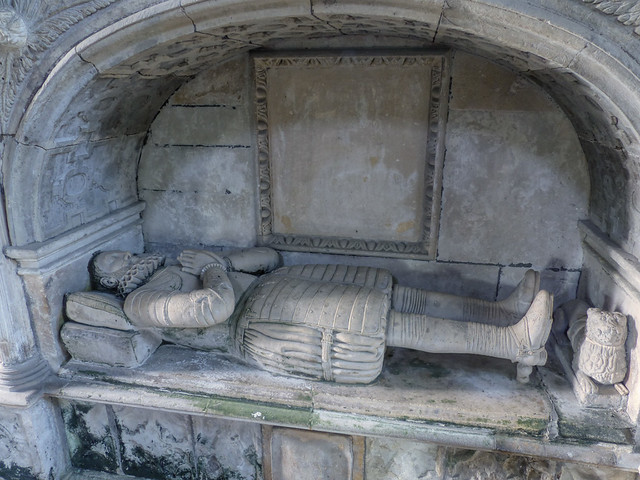
This recumbent effigy, commemorating Fulk Woodhul, dates from the early seventeenth century and is located in the church at Thenford, Northamptonshire. The monument presents the deceased lying full-length within an arched recess, a format that continued medieval funerary traditions while adapting them to post-Reformation sensibilities.
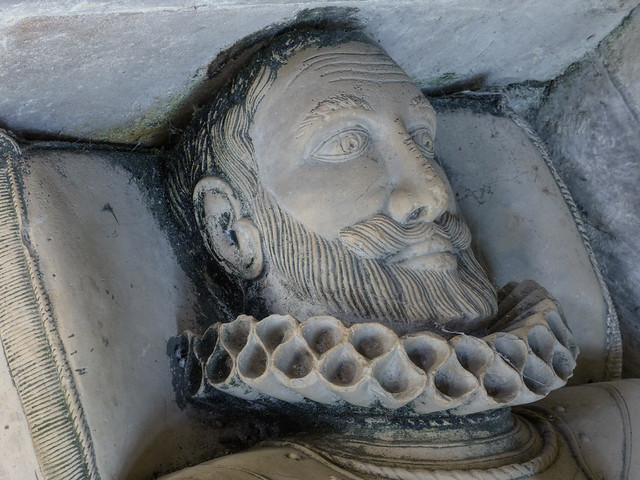
Woodhul is shown wearing late Elizabethan armour, including a breastplate, articulated arm defences, and a skirt of tassets, indicating his status as a gentleman of local standing rather than a professional soldier. Around his neck he wears a prominent cartwheel ruff, firmly anchoring the effigy stylistically to the period around 1600. His hands are joined in prayer, a gesture retained in English funerary sculpture after the Reformation as a sign of personal piety rather than intercessory devotion.
The head rests on a cushion, and at the feet is a small heraldic beast, possibly a lion or dog, symbolising status, vigilance, or loyalty. The facial carving is particularly attentive, with a neatly trimmed beard, moustache, and alert, open eyes, suggesting an interest in individual likeness rather than purely symbolic representation.
Although the effigy preserves medieval conventions—recumbency, prayerful pose, architectural canopy—it reflects early modern values through its emphasis on social rank, lineage, and sober commemoration. As such, it stands as a representative example of Jacobean funerary sculpture in rural Northamptonshire, marking the continuity and gradual transformation of monumental forms in the decades following the Reformation.
