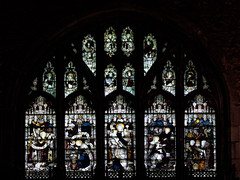
This east window at St. Peter's Church in Market Bosworth, was created by Charles E. Kempe in 1900 (with later contributions from the Kempe and Tower studio)

This east window at St. Peter's Church in Market Bosworth, was created by Charles E. Kempe in 1900 (with later contributions from the Kempe and Tower studio)
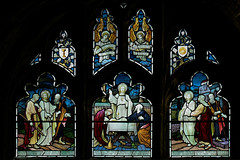
The Emmaus window by Heaton, Butler & Bayne, created in 1925, is a stained-glass triptych set in a South chancel window at Market Bosworth. Made by the London firm known for its Victorian and Pre-Raphaelite style, it depicts the biblical Supper at Emmaus across three panels.
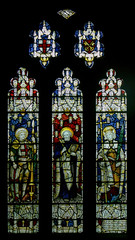 This stained glass window by Charles Eamer Kempe, at St Peter's Market Bosworth Leicestershire, is an example of late Victorian Gothic Revival art, depicting Saints George, Peter, and Margaret in three tall, richly colored panels. Each saint stands beneath an elaborate architectural canopy, rendered in delicate tracery and glowing jewel tones that catch and filter the light with remarkable depth.
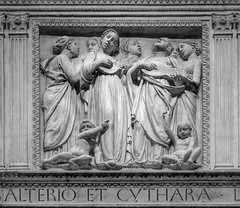
Between 1431 and 1438, the Florentine sculptor Luca della Robbia carved in marble one of the most radiant celebrations of music and childhood in the early Renaissance, the Cantoria, or singing gallery, originally made for the north singing gallery of Florence Cathedral.
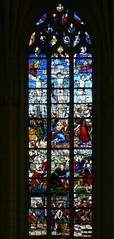
The Crucifixion window in the Church of Saint John the Baptist at Montrésor, in the Indre-et-Loire region of France, is one of the finest surviving examples of early sixteenth-century stained glass in the Loire Valley. Filling a tall Gothic lancet divided into several vertical lights, it unfolds as a vivid narrative of the Passion of Christ, rendered in rich Renaissance color and form.
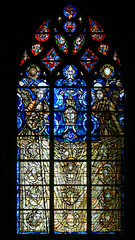
Pierre Carron’s Millennium Windows at Orléans Cathedral stand as luminous meditations on creation, light, and faith renewed at the turn of the twenty-first century. Set within the soaring Gothic tracery of the cathedral, they bridge centuries of sacred art by merging medieval structure with a modern painter’s vision.
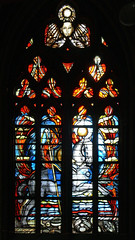
This stained glass window, crafted by the French artist Pierre Carron in 2000, graces the south-facing lancet of the Cathédrale Sainte-Croix d'Orléans, a Gothic edifice spanning the 13th to 19th centuries. This modern addition, bathed in the interplay of light, celebrates the heroic figure of Joan of Arc, the city’s revered patron saint
Â
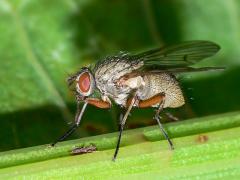
Helina impuncta is a fairly common species of fly belonging to the Muscidae family, the same family that includes the familiar house flies and stable flies. It is found throughout much of Europe, including the UK, and is most often seen in woodlands, hedgerows, and shaded grassland areas.

Â
Â
Â
The Common Long-legged Fly (Dolichopus trivialis) is one of the most frequently seen members of the Dolichopodidae family in the UK. Like its relatives, it is a small, slender, metallic-green fly with long legs and a fast, darting flight.
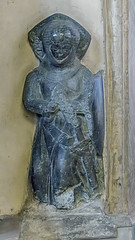
The Memorial to Robert de Ros (c. 1237–1285) is a poignant 13th-century stone effigy and heart monument housed in the Church of St. Mary the Virgin in Bottesford, Leicestershire.
