
Volucella inanis
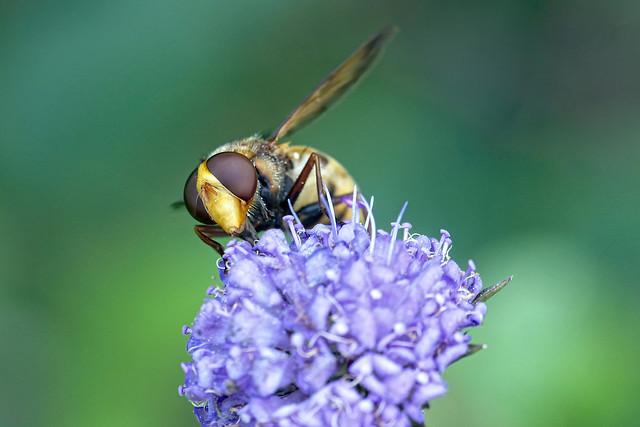
Taxonomy
External Links
Volucella inanis, the large and striking hoverfly often mistaken for a hornet, has a life cycle that is intimately tied to social wasps. The female does not lay her eggs on flowers or vegetation, as many syrphids do, but instead seeks out the nests of ground-nesting wasps, typically species of Vespula. Attracted by the odour of the colony and protected by her convincing wasp-like appearance, she is able to approach the entrance without provoking an attack. She inserts her eggs into the nest, either by flicking them through the opening or by briefly entering the outer chambers.

Once hatched, the larvae live within the wasp nest itself, a warm, sheltered environment rich in organic material. Their diet appears to be mixed: they will consume dead or dying wasp larvae, discarded nest debris, and in some cases weakened live brood. Although sometimes described as parasitic, they behave more accurately as opportunistic predators and scavengers, exploiting whatever food resources the wasp colony provides. Their presence rarely causes major harm to a healthy nest, but in smaller or stressed colonies they may significantly reduce brood numbers.
As they grow, the larvae move deeper into the nest structure, eventually reaching full size before crawling out of the colony to pupate in the surrounding soil. The adult hoverflies emerge later in the summer, completing a life cycle that relies on a delicate balance: entering a wasp nest is dangerous, but the protection and abundance of food make it an ideal nursery for a species exquisitely adapted to exploiting it.