
Platystomatidae
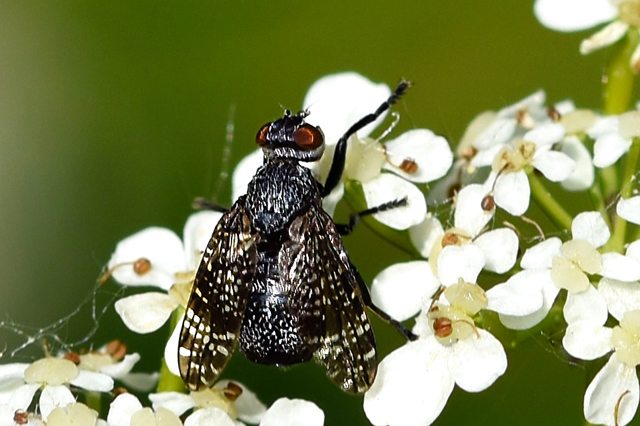
Les Platystomatidae, communément appelés mouches signal, forment une famille de mouches acalyptates caractérisées par leurs ailes souvent richement décorées et leur comportement de parade nuptiale distinctif.
Les membres de cette famille sont des mouches de taille moyenne, au corps robuste et à la tête relativement large portant des yeux composés bien développés. Leurs antennes sont courtes à moyennes, avec généralement un troisième segment arisé. Le thorax et l'abdomen présentent une coloration variable, fréquemment ornée de motifs contrastés, clairs et foncés.
Les ailes constituent un trait distinctif. De nombreuses espèces arborent des bandes, des taches ou des motifs réticulés bien visibles, qu'elles mettent en valeur par des mouvements d'ailes. La nervation alaire est bien développée, avec une cellule discale fermée et des nervures transversales clairement définies, permettant de les distinguer des mouches à ailes tachetées, d'apparence similaire.
Les larves sont saprophages et se développent dans des matières organiques en décomposition telles que la végétation morte, la litière de feuilles, le bois en décomposition ou les excréments. On rencontre fréquemment les adultes en lisière de forêt, dans les broussailles, les haies et les prairies, où ils se nourrissent de nectar, de miellat ou d'autres liquides de surface associés à la décomposition de matières organiques.
Les Platystomatidae sont présents dans le monde entier, avec une plus grande richesse spécifique dans les régions tropicales et subtropicales, bien qu'une faune plus restreinte mais caractéristique soit présente dans les zones tempérées. Dans la région paléarctique, des genres tels que Rivellia figurent parmi les plus fréquemment recensés.
Au sein des Diptères, les Platystomatidae sont connus pour leurs comportements et leur apparence remarquable, ce qui en fait l'une des familles les plus reconnaissables au sein des Tephritoidea.
Send feedback