
South chancel window - Middleton Cheney

The south window of the chancel at All Saints, Middleton Cheney, contains two important stained-glass panels designed by Ford Madox Brown in 1870, created during his period of work for Morris, Marshall, Faulkner & Co. These windows are among the finest surviving examples of Brown’s contribution to Victorian ecclesiastical glass, characterised by his expressive figures, sculptural modelling, and dense narrative detail.
Panel 1 – Melchizedek and Abraham
The first panel depicts Melchizedek, priest-king of Salem, offering bread and wine to Abraham ⓘ after his victory over the kings (Genesis 14:18–20). Brown renders Melchizedek in rich priestly robes embroidered with sheep, while Abraham kneels bare-armed in armour, receiving the chalice. The composition embodies the Victorian theological interpretation of Melchizedek as a typological precursor to Christ and the Eucharist.
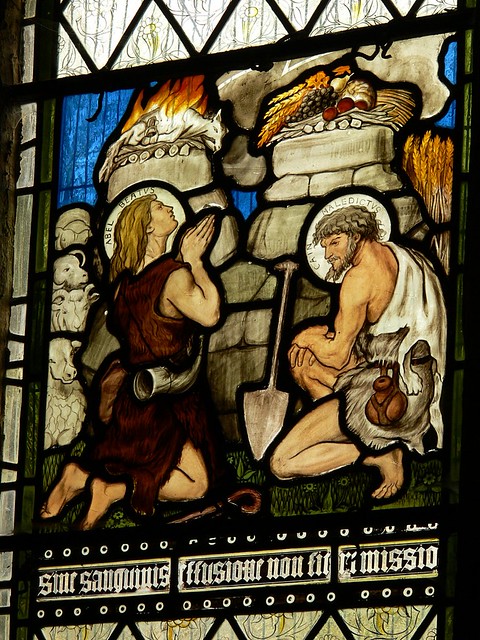
Panel 2 – The Offerings of Abel and Cain
The second panel depicts Abel and Cain presenting their offerings to God (Genesis 4:3–5). Abel kneels before a blazing altar of lambs, while Cain offers the “fruits of the ground” on a separate stone. Brown emphasises the emotional tension: Abel prays in humility, while Cain crouches with visible frustration, his jaw clenched beneath the inscription “Vae Dicitio” (a reference to divine rejection). The Latin scroll below recalls the theological theme of sacrifice:
“Sine sanguinis effusione non fit remissio”
(Without the shedding of blood there is no remission).
Artistic Significance
These panels reflect Ford Madox Brown’s distinctive Pre-Raphaelite-inflected approach: muscular bodies, sharply contoured drapery, and densely symbolic detail. The window forms part of a wider, exceptionally rich decorative scheme at Middleton Cheney, one of the most important rural churches for stained glass by Morris & Co. and its circle.
