Pre Raphaelite

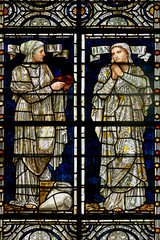
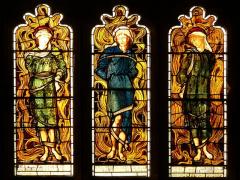
Ford Madox Brown  - St Elizabeth


Ford Madox Brown was born on 16 April 1821 in Calais to English parents, and received his artistic training at the Académie des Beaux-Arts in Antwerp, where the rigorous academic tradition left a lasting imprint on his draftsmanship and compositional discipline. Though Brown spent much of his early life moving between the Continent and England, he established himself in London during the 1840s as a painter of historical and moral subjects.


Founded as Morris, Marshall, Faulkner & Company in 1861 by the socialist artist and designer William Morris along with Ford Madox Brown, Dante Gabriel Rossetti, Peter Paul Marshall, Philip Webb, Charles James Faulkner, and Edward Burne-Jones. The company initially concentrated on ecclesiastical decoration including stained glass, and architectural carving from premises in London’s Red Lion Square, but moved to Queens Square, Bloomsbury in 1865.


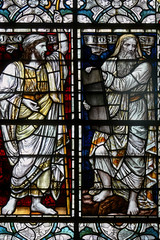
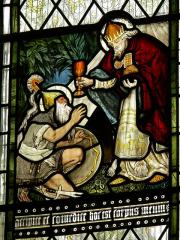
The south window of the chancel at All Saints, Middleton Cheney, contains two important stained-glass panels designed by Ford Madox Brown in 1870, created during his period of work for Morris, Marshall, Faulkner & Co. These windows are among the finest surviving examples of Brown’s contribution to Victorian ecclesiastical glass, characterised by his expressive figures, sculptural modelling, and dense narrative detail.


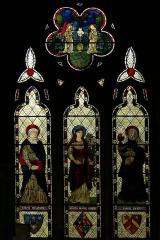
St Elizabeth, Virgin Mary, St Anne


The north-aisle east window at Middleton Cheney contains two major stained-glass figures designed by Ford Madox Brown in 1880 for Morris, Marshall, Faulkner & Co. These works represent some of Brown’s finest ecclesiastical contributions and exemplify his distinctive approach to figural design, which differs markedly from that of colleagues such as Burne-Jones.


The story of stained glass in England is one of both loss and renewal. The medieval and Renaissance centuries had produced a luminous synthesis of theology, craft, and architecture, an art that translated divine light into visible doctrine. Yet, with the Reformation and subsequent waves of iconoclasm, much of this splendour was extinguished. For nearly three hundred years, the craft languished, its techniques fragmented and its spiritual vocabulary forgotten


William Morris (1834–1896) stands as one of the central figures in the revival of British stained glass during the second half of the nineteenth century. Through the firms Morris, Marshall, Faulkner & Co. and later Morris & Co., his designs — and those of his close collaborators, especially Edward Burne-Jones, Ford Madox Brown, and Dante Gabriel Rossetti — transformed the visual language of Victorian church decoration.


Subscribe to Pre Raphaelite