
St. Elizabeth and St. Anne - Middleton Cheney
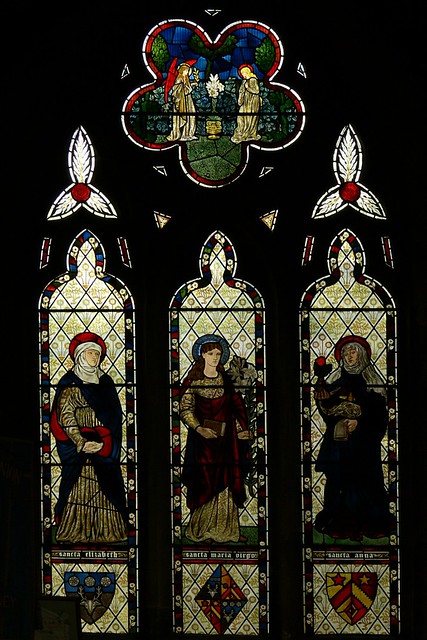
The north-aisle east window at Middleton Cheney contains two major stained-glass figures designed by Ford Madox Brown in 1880 for Morris, Marshall, Faulkner & Co. These works represent some of Brown’s finest ecclesiastical contributions and exemplify his distinctive approach to figural design, which differs markedly from that of colleagues such as Burne-Jones ⓘ.
Left Light — St Elizabeth (Ford Madox Brown)
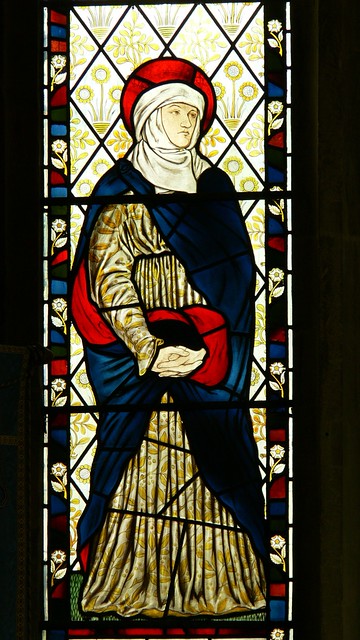
Brown’s figure of St Elizabeth, mother of John the Baptist ⓘ, is monumental and sculpturally weighted. She stands wrapped in a dark blue mantle over a richly patterned golden robe, executed with the dense folds and textured surfaces characteristic of Brown’s draughtsmanship. Her expression is solemn and introspective, emphasising her role within the narrative of the Incarnation.
The figure displays Brown’s preference for earthy, corporeal realism over the ethereal idealism favoured by Burne-Jones, offering a grounded counterpoint to the window’s central panel.
Right Light — St Anne (Ford Madox Brown)
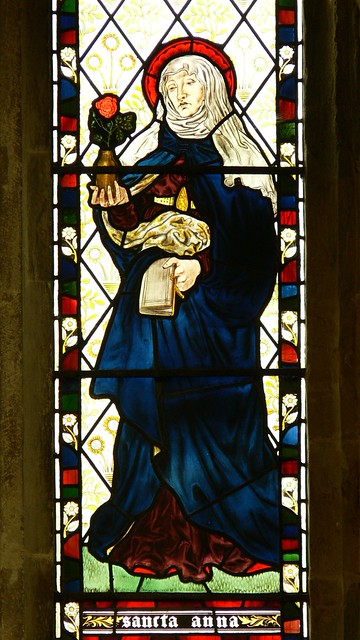
Opposite St Elizabeth, Brown’s St Anne also carries his unmistakable visual signature. She is shown holding a vessel of flowers. The face is expressive and humanised.
Brown’s use of deep blues, reds, and ochres complements but does not mimic the palette of the adjacent Burne-Jones figure, contributing to the striking triptych-like balance of the window.
Stylistic Significance
These Middleton Cheney panels illustrate Ford Madox Brown’s central role within the Morris, Marshall, Faulkner & Co. workshop during the late 19th century. Although never formally part of the Pre-Raphaelite Brotherhood, Brown stands alongside Rossetti and Morris in shaping the Firm’s early identity.
His figures here show:
-
robust physical presence, heavy limbs, and sculptural contouring
-
medievalising drapery rooted in his admiration for early Northern art
-
expressive realism, avoiding the abstracted spiritual detachment of Burne-Jones
Context within the Window
Though the overall scheme is collaborative, the two lateral lights by Brown form a coherent pair, framing the more idealised Virgin by Burne-Jones at the centre and supporting the overarching Marian theme of the window. The tracery Annunciation by William Morris above further unites the composition, though its style contrasts sharply with Brown’s earthy humanism.
Together, these two lights constitute one of the strongest surviving examples of Ford Madox Brown’s stained-glass work outside major urban churches, and demonstrate his important, sometimes under-recognised, contribution to the decorative programme of Morris & Co.
