Rosenkrantz, Arild
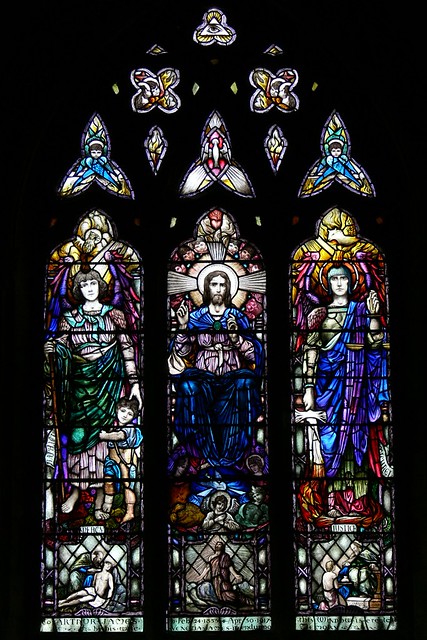
Born in 1870 at Frederiksborg Castle, Denmark, Arild Rosenkrantz was the son of the Danish minister to Italy, a background that gave him an early international outlook and access to continental artistic culture. Although Danish by birth, he spent much of his professional life working abroad, particularly in England, where he became closely associated with the late Victorian and Edwardian revival of stained glass.
Rosenkrantz trained as a painter at the Académie Julian in Paris, an experience that grounded him in academic figure drawing while leaving him receptive to more experimental currents in modern art. His work in stained glass reflects this dual formation, combining disciplined draughtsmanship with a highly personal, imaginative approach to colour and symbolism.
In 1896, Rosenkrantz spent a formative year in the United States, working at The Decorative Stained Glass Company in New York. During this period he contributed to the memorial window for James Gallatin, later installed at Wickhambreaux, Kent. This window is notable as the first American stained-glass window to be exported abroad, marking a rare transatlantic exchange in late 19th-century ecclesiastical art. While in America, Rosenkrantz also designed a window for Tiffany Studios, on the subject of King Alfred the Great, demonstrating his ability to adapt his style to different workshop contexts.
Stylistically, Rosenkrantz was deeply influenced by the Pre-Raphaelites, above all Edward Burne-Jones ⓘ, whose emphasis on linear grace, idealised figures, and symbolic narrative strongly shaped his approach to stained glass. Other important influences included William Blake, whose visionary imagery resonated with Rosenkrantz’s imaginative temperament, and J. M. W. Turner and Claude Monet, whose explorations of light and atmosphere informed his sensitive use of colour and tonal modulation. The result is a body of work that bridges Pre-Raphaelite idealism and a more modern, painterly understanding of light, situating Rosenkrantz as a distinctive and cosmopolitan figure in turn-of-the-century stained glass.