
Galland and Gibelin
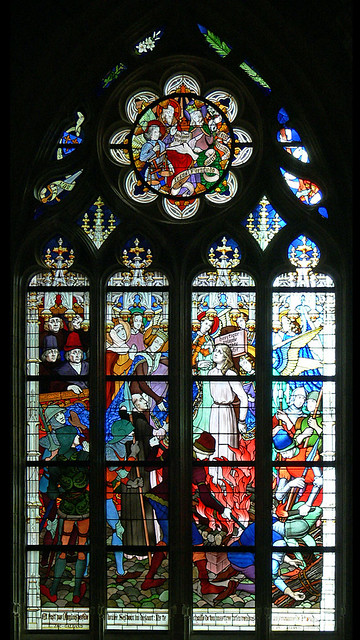
The ten stained-glass windows illustrating the Life of Joan of Arc in the Cathedral of Sainte-Croix at Orléans, completed in 1897, were the collaborative achievement of Jacques Galland, a painter of refined academic training, and Esprit Gibelin, a master glassmaker whose workshop was among the most accomplished in central France. The two artists won the 1893 competition to produce the glazing scheme for the cathedral’s nave aisles—five scenes to the north and five to the south—representing episodes from Joan’s vocation to her martyrdom.
Jacques Galland (1822–1902) brought to the project the discipline of a painter steeped in the traditions of the École des Beaux-Arts. His compositions reveal a clear academic structure: figures carefully modelled, gestures hieratic yet expressive, and settings rendered with historical accuracy. Galland’s cartoons for Orléans exemplify the late-nineteenth-century synthesis of painterly realism and spiritual narrative, treating the glass surface as a luminous equivalent to fresco or canvas. His use of measured symmetry and subdued pathos ensured that the windows balanced narrative drama with devotional dignity.
Esprit Gibelin (1833–1908), trained both as artisan and entrepreneur, translated Galland’s designs into glass with remarkable technical finesse. His Orléans workshop, founded in the 1860s, had already established a regional reputation for precision cutting, subtle shading, and a restrained yet radiant palette. In the Joan of Arc cycle, Gibelin’s craftsmanship is evident in the seamless modulation of flesh tones, the modelling of armour and drapery through layers of silver stain and enamel, and the careful orchestration of light to emphasise narrative climax. His choice of pot-metal blues and reds, balanced by transparent architectural grisaille, allowed the painter’s compositions to breathe within the cathedral’s vast interior.
Together, Galland and Gibelin embody the ideal partnership between designer and glassmaker that characterised French stained-glass practice in the late nineteenth century. Galland’s pictorial intelligence found its material counterpart in Gibelin’s mastery of the medium, resulting in windows that unite academic draughtsmanship with luminous craftsmanship. Their collaboration demonstrates the persistence of traditional atelier structure at a moment when industrial processes threatened to eclipse individual artistry.
The Joan of Arc windows thus stand not only as a monument to their national heroine but as a testament to two craftsmen at the height of their powers—Galland, the storyteller in line and colour, and Gibelin, the interpreter of light—whose combined skill transformed narrative painting into radiant architecture.
