
North aisle, central window — Braunston, Northamptonshire
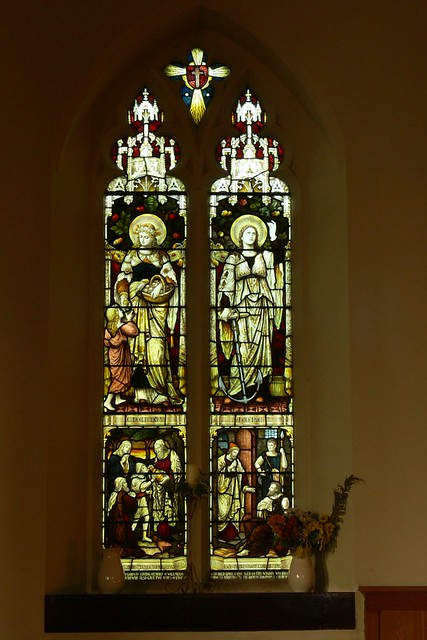
This two-light window presents an allegorical programme centred on the theological virtues, complemented by scenes illustrating the Works of Mercy, a pairing characteristic of late Victorian ecclesiastical stained glass.
Left-hand light:
In the upper register, Charity is personified as a female figure offering food to a child, an image of compassionate giving rooted in Christian moral teaching. Below, the theme of Giving drink to the thirsty is illustrated, accompanied by the biblical inscription “I was thirsty and ye gave me drink” (Matthew 25:35), aligning the allegory above with practical acts of mercy.
Right-hand light:
The upper register depicts Hope, identified by the anchor she holds, a traditional symbol of steadfast faith and expectation of salvation. The lower scene represents Visiting the prisoner, with the inscription “I was a prisoner and ye came to me” (Matthew 25:36), reinforcing the moral imperative of compassion towards the marginalised.
Tracery light:
Above the two lights, a radiant cross set within a shield symbolises Faith, completing the triad of theological virtues—Faith, Hope, and Charity—that structure the window’s iconography.
The window is typical of the work of Heaton, Butler & Bayne in the late nineteenth century, combining clear figural drawing with legible moral symbolism. The careful alignment of allegory and scripture reflects Victorian concerns with moral instruction, social responsibility, and the practical expression of Christian belief within a parish context. Here the figure of Charity is integrated into a carefully structured moral programme pairing allegory with scripture. Set above the scene of Giving drink to the thirsty, the personification of Charity provides a visual key to the Works of Mercy illustrated below, linking abstract virtue with concrete acts of compassion.
The reuse of the same cartoon, for Charity, in a window at Staverton, barely five miles away, points to the local circulation of standard designs by Heaton, Butler & Bayne, and to the firm’s practice of deploying familiar allegorical figures across neighbouring parishes. In this context, repetition reinforces legibility and moral clarity rather than originality, ensuring that the message of charitable action was immediately recognisable to late nineteenth-century congregations.