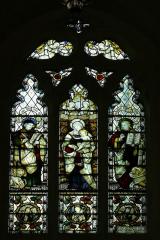
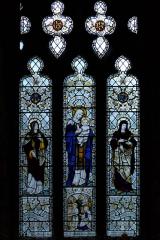
Faith, Hope, Charity - Staverton, Northamptonshire

Faith, Hope, and Charity by Heaton, Butler & Bayne (1896). Staverton.
Faith, Hope, and Charity by Heaton, Butler & Bayne (1896). Staverton.
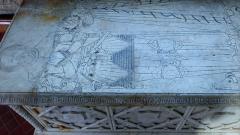
Francis Tanfield was a member of a gentry family long settled at Gayton, Northamptonshire. The Tanfields held land in the county from at least the 14th century, and like many such families, maintained their position through estate management and service in local administration. Francis died in 1558, and his monument in St Mary’s Church was probably commissioned by his widow soon afterwards.
This wall memorial tablet commemorates Frederick John Salmon Bagshaw, lieutenant and adjutant of the 36th Regiment, Bengal Native Infantry, who died during the opening phase of the Indian Rebellion of 1857. The tablet is located at Thrapston, Northamptonshire, the parish of which his father, W. S. Bagshaw, was rector.
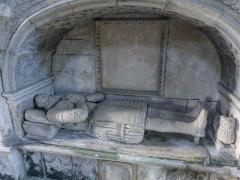
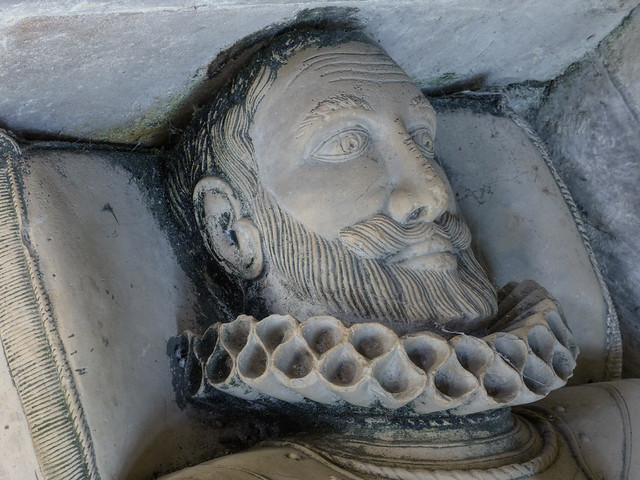
This recumbent effigy, commemorating Fulk Woodhul, dates from the early seventeenth century and is located in the church at Thenford, Northamptonshire. The monument presents the deceased lying full-length within an arched recess, a format that continued medieval funerary traditions while adapting them to post-Reformation sensibilities.
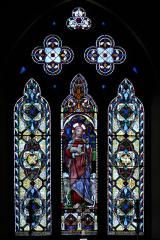
This three-light stained-glass window of 1873, made by Jones & Willis, is located in the church at Tiffield. The composition centres upon Christ as the Good Shepherd, framed by richly ornamented geometric glazing.

South chancel lancet windows by Edward Burne-Jones ⓘ dedicated to Countess Adelaide Spencer (d1877).
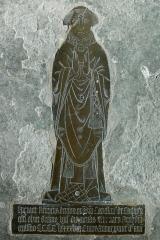
Henry Denton (1498) chaplain of Chelveston, a small village near to Higham Ferrers.
This remarkable window (1490-1505), rediscovered packed away in 1932, forms the lower section of the great east window at Stanford-on-Avon. It is one of the most striking survivals of late medieval royal propaganda in stained glass, created to celebrate the accession and legitimacy of Henry VII and the founding of the Tudor dynasty.
Two Kempe and Tower windows from 1914. The first shows St Luke ⓘ, Virgin and Child, and St John the Evangelist ⓘ. The upper lights of the second window shows the Epiphany whilst the bottom light depict the Presentation in the Temple.
This three-light stained glass window of 1926, signed by J. Powell & Sons (Whitefriars), presents a symbolic devotional programme centred on Christian virtue rather than named saints.