
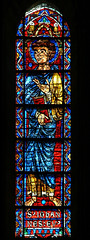
 Window 204 consists of two tall lancets forming part of the celebrated early thirteenth-century clerestory glazing of Bourges Cathedral. The saints represented, Andrew on the left and John the Evangelist on the right, are shown as full-height standing figures beneath architectural canopies, framed by the characteristic geometric borders of the Bourges workshop.
Stained Glass
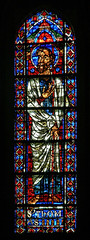
Window w.206 forms part of the major early 13th-century glazing programme of the choir clerestory at Bourges Cathedral. Like the other apostolic lancets in this zone, it presents three full-length apostles standing beneath architectural canopies, each framed by the characteristic red–blue geometric borders of the Bourges workshop. The style, palette, and facial types align closely with the glazing campaigns dated to c.1210–1215.
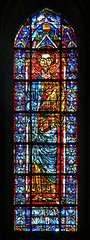
Window w.210 forms part of the southern clerestory apostolic cycle of Bourges Cathedral. Created in the first decades of the 13th century, this scheme is contemporary with the cathedral’s great choir and represents one of the finest ensembles of High Gothic stained glass in France.
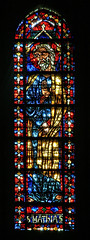
Window w.212, located high in the south choir clerestory of Bourges Cathedral, dates from c.1210–1215 and belongs to the earliest glazing phase of the High Gothic choir. The window presents two Evangelists, Mark and Luke, and one Apostle, Matthias.
This trio forms part of a wider apostolic–evangelist cycle distributed around the clerestory, each figure shown as a monumental standing saint set within a richly patterned Gothic frame.

Window at Middleton Cheney were designed by Burne-Jones (1893) as a memorial to his friend W.C. Buckley
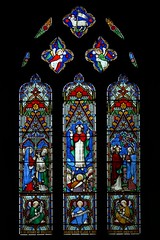
William Wailes (1808-1881) was born in Newcastle and originally started grocery and tea-dealing business. He studied the manufacture of stained glass in Munich in the 1830s, and by 1838 start his own company in Newcastle-upon-Tyne.
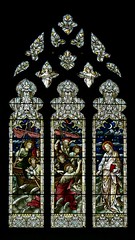
This window by Hardman (1892) is Christ in Glory with the prophets Moses and Elijah to the left and right.

The company began in 1836 as Ward and Nixon, the two worked together for twenty years, exporting windows all over the world. In 1855 they were given the contract for re-glazing of East Window of Lincoln Cathedral. By which time James Nixon started to take less active part in the business and died in 1857.
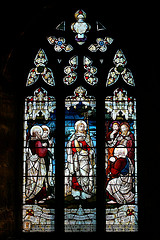
Memorial Window to William Walter Slye by CE. Kempe (1906) - All Saints, West Haddon.
 Christopher Whall (1849-1924), studied art at the Royal Academy Schools where he became influenced by the Pre-Raphaelites. After leaving the Royal Academy in 1879 he specialized in stained glass, working for John Powell & sons as a designer, but started his own company when he wanted to learn the whole craft of stained glass making.
Pages
