18th century church monuments
Church brasses, tomb chests, effigies, and sculpture from 1700 - 1800 AD.
Church brasses, tomb chests, effigies, and sculpture from 1700 - 1800 AD.
18th-century brasses (c. 1701–1800) are rare survivals of an earlier commemorative tradition. When used, they are typically modest and inscriptional, reflecting Enlightenment restraint and the declining role of figurative imagery in Protestant memorial culture.
18th-century tombs (c. 1701–1800) are comparatively uncommon and generally restrained in form. When present, they emphasize classical proportion, lineage, and moral virtue rather than effigial display, reflecting Enlightenment ideals of reason and decorum.
18th-century wall monuments (c. 1701–1800) dominate church commemoration. Marble tablets and architectural compositions combine inscription, classical ornament, and allegorical imagery to celebrate character, benevolence, and domestic virtue within a Protestant moral framework.
John Bacon the Younger (1777–1859) was an English sculptor best known for church monuments and commemorative sculpture in the early nineteenth century. The son of the sculptor John Bacon RA, he was trained within a firmly established neoclassical tradition and continued his father’s practice while adapting it to changing tastes in the post-Georgian period.
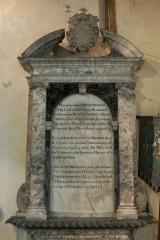
Architectural monument to commemorate members of the Benson family c1730. Probably by Smith of Warwick ⓘ.
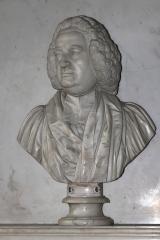
This bust of Bishop of Worcester James Johnson (d1774), is by Joseph Nollekens ⓘ.
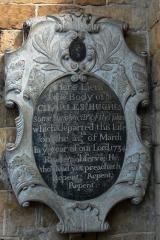
Plaque to Charles Hughes (d1734).
John Flaxman (1755–1826) was an English sculptor, draughtsman, and designer, and one of the most influential figures in British Neoclassicism. His importance lies as much in his role as a designer of sculpture as in the execution of carved works, and his impact extended well beyond Britain through the wide circulation of his designs.
Giulio Foggini (1652–1725) born Giovanni Battista Foggini, was an Italian sculptor active in Florence during the late Baroque period. He was one of the most accomplished sculptors working in Tuscany at the turn of the eighteenth century, known for his dynamic figural compositions, expressive modelling, and refined handling of marble and bronze.