Moses Macham Brass- Ryton-on-Dunsmore, Warwickshire
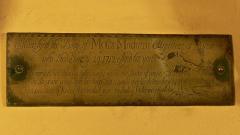
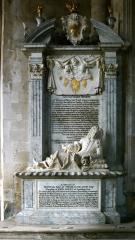
Brass monument to Moses Macham (d1712).
Brass monument to Moses Macham (d1712).
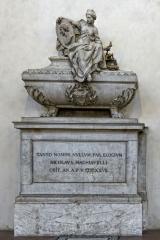
This tomb, dedicated to Niccolò Machiavelli (d1527), was created by Innocenzo Spinazzi ⓘ in 1787, and is in Santa Croce Florence.
Joseph Nollekens (1737–1823) was one of the leading English sculptors of the late eighteenth and early nineteenth centuries, renowned for his portrait busts, ideal figures, and monuments executed in a refined Neoclassical style. His career spans the period in which British sculpture fully absorbed and adapted Continental classical models into a confident national idiom.
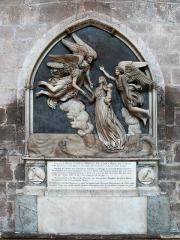
This monument by John Flaxman ⓘ is to Sarah Morley (d1784) who died a few days after giving birth whilst travelling back to England from India. Both Sarah and her child were buried at sea.
[no-context]Smith of Warwick ⓘ refers to the family workshop established by Francis Smith (1672–1738) and continued by his son William Smith (1705–1764), active across Warwickshire, the Midlands, and beyond from the late seventeenth through the mid eighteenth century. The workshop was one of the most prolific and influential provincial centres for architectural and monumental sculpture in early Georgian England.
Innocenzo Spinazzi (1726–1798) was an Italian sculptor active in Florence during the later eighteenth century. He is best known for allegorical and decorative sculpture executed in a refined Neoclassical style, marking the transition from late Baroque expressiveness to a more controlled classical idiom.
Robert Taylor (1690–1742) was a leading English sculptor and mason of the early eighteenth century, active within the professional statuary and architectural tradition of the early Georgian period. Apprenticed to Richard Garbut, he is recorded as active from 1712, and went on to hold major institutional appointments that place him among the most important sculptors of his generation.
Mauro Antonio Tesi (1730–1766), often known as Mauro Tesi ⓘ, was an Italian painter, draughtsman, and architect active in Bologna and Rome during the mid eighteenth century. He is best known for architectural compositions and capricci that combine Baroque spatial drama with an emerging classical discipline.
White marble monument to Thomas Deacon (d1721) and wife.
This memorial to Sir Thomas Street (d1696) is the work of the sculptor Joseph Wilton ⓘ a founding member of the Royal Academy, and was made around 1774.