
Index of Tudor all
Attributed to John Wakeham (d1549), the last abbot of Tewkesbury, the 'Wakeham' Cenotaph, actually mid fifteenth century and pre-dates the abbot by about 100 years. The effigy is a gisant as a decomposing corpse and the canopy was modelled on the throne of the House of Lords.

This remarkable window (1490-1505), rediscovered packed away in 1932, forms the lower section of the great east window at Stanford-on-Avon. It is one of the most striking survivals of late medieval royal propaganda in stained glass, created to celebrate the accession and legitimacy of Henry VII and the founding of the Tudor dynasty.

Memorial brass of Thomas Andrewes (d1496) and his wife Margaret. Holy Trinity, Church Charwelton, Northamptonshire.

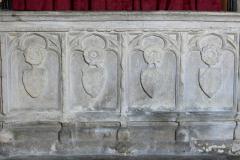
Tomb of John Wales vicar (d1496).
Henry Denton (1498) chaplain of Chelveston, a small village near to Higham Ferrers.

18 inch high brass figure of a lady (c1500).

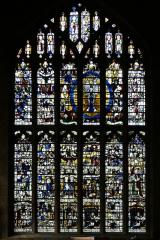
This scene depicting the Coronation of the Virgin forms part of the Magnificat Window of 1501 in the north transept of Great Malvern Priory and extends across three lights, emphasising both its theological importance and its visual prominence within the wider glazing scheme. The subject, drawn from late medieval Marian devotion, celebrates Mary’s exaltation in heaven following her Assumption, a theme closely aligned with the Magnificat’s emphasis on humility rewarded by divine grace.
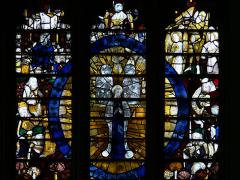
These panels from the 'Magnificat' window (1501) at Malvern Priory depict the Archangel Michael on the left. On the top right is Jesus ascent into Heaven, whilst the bottom right panel shows the damned descent into hell.
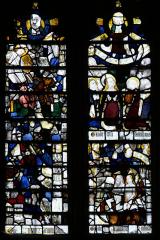
This window in the North transept of Great Malvern Priory was a gift from Henry VII in 1501. Containing scenes from the life of the Virgin Mary and the life of Christ., it is known as the Magnificat window because it contains the Song of Mary from Luke 1:46-55.
This chantry chapel to Arthur Tudor, covered in tracery and sculptures, was built in 1504. The chest tomb of the 15 year old Prince fills the chapel.

Monumental brass dedicated to William Thorpe (d1504) and his wife Marion. Two figures 2ft 1in in height, with scrolls and inscription.

Brass of Thomas Knightley (1516).

Set within the tracery lights of the great east window at St Peter’s, Coughton, these panels form part of a distinguished group of Tudor heraldic glass. At the centre are the royal arms of Henry VIII, impaled with those of Catherine of Aragon, enclosed by the initials H and K and surrounded by the Tudor emblems of the rose, portcullis, and crown. The inclusion of Catherine’s arms confirms that the glass was installed before the annulment of their marriage in 1533, most likely during the first decade of Henry’s reign.

Freestanding tomb to Sir Richard Knightley (d1534) and his wife Jane Skenard.
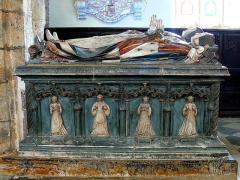
Situated behind the main altar in Worcester cathedral this effigy is said be that of William Moore (1518-1536), the prior of the Benedictine Priory of St Mary's Worcester.
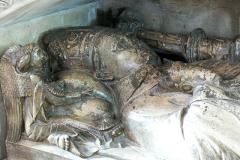
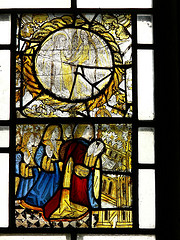
The roundels are late C15 to early C16. The figures of the donor family are mid C16 and probably come from Stanford Hall.
Thomas Andrewes shown in armour and bare headed, whilst his wife Agnes wears a huge head-dress and the long hanging sleeves fashionable at the time.

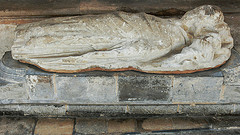
Effigy of John Chambers (d1556) last abbot and first bishop of Peterborough. Described in the 17th century as being exquisitely carved, with a mitre and robe, and feet resting on a lion, this effigy was mutilated during the English Civil War.
Francis Tanfield was a member of a gentry family long settled at Gayton, Northamptonshire. The Tanfields held land in the county from at least the 14th century, and like many such families, maintained their position through estate management and service in local administration. Francis died in 1558, and his monument in St Mary’s Church was probably commissioned by his widow soon afterwards.

Alabaster free standing tomb to Thomas Cave (c1558).
