
Index of Romanesque all
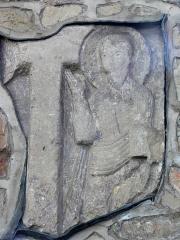
Fragment of saint giving a blessing.
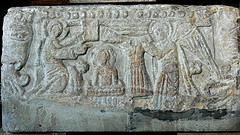
Discovered in 1887 this C12 square bowled font has carved scenes from the life of Crist on all four sides.
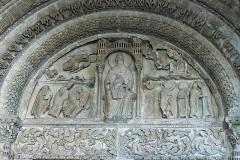
The north portal of Bourges Cathedral is dedicated to the Virgin Mary. The Tympanum dates from between 1160 and was part of the older church the the Gothic cathedral replaced. This portal suffered a lot of damage during the Wars of Religion in 1562.
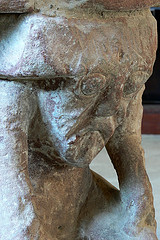
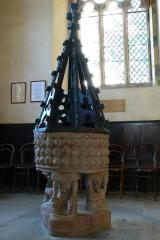
This C12 font has a circular bowl with a bead decoration which is supported by three crouching Atlas figures supporting the red sandstone bowl.
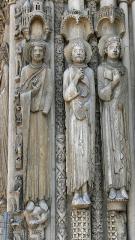
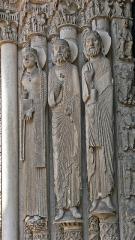
Since its construction in around 1150, the western portal of Chartres Cathedral, decorated with elongated late Romanesque style figures of the Kings and Queens of the Old Testament has been known as the Royal Portal.
 ,
, 
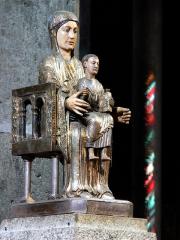
In form and iconography, the statue is closely modelled on the celebrated “Golden Virgin” commissioned by the Bishop of Clermont in 946, a cult image that was destroyed during the Revolution when it was melted down for coinage. On stylistic and material grounds, the Orcival Virgin is now dated to c. 1170, making it a later but faithful reinterpretation of the earlier episcopal image.
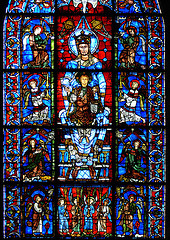
Set into a 13th century window, in the south ambulatory of the choir (bay 44) of Chartres Cathedral, this is one of the most celebrated medieval artworks in the Cathédrale Notre-Dame de Chartres.It dates primarily to c. 1180 CE, with later additions around 1225 CE, making it a rare survivor from the pre-1194 fire that destroyed the earlier Romanesque cathedral.
Tomb of King Henry II of England at Fontevraud Abbey, France.

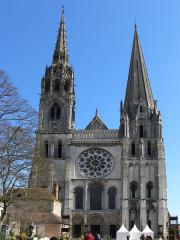
Designated a World heritage Site by UNESCO in 1979 the Cathedral of Notre-Dame de Chartres was built from between 1145 and 1250. It's high nave is spanned by ogival pointed arches to form the vault, and the walls are supported by double flying buttresses. Chartres is the first building to have used buttresses as a structural element.
Chartres Cathedral is also unique in having retained almost all of its original 12th and 13th century stained glass.
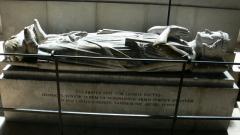
Tomb of Richard I of England (d1199). This is one of three tombs to Richard I, this one is said to contain his heart, his entrails were buried in Châlus (where he died), and the rest of his body was buried at the feet of his father, Henry II, at Fontevraud Abbey in Anjou.

Tomb of Henry the Young King (d1183) son of Henry II of England and Eleanor of Aquitaine, brother of King Richard I of England and King John.
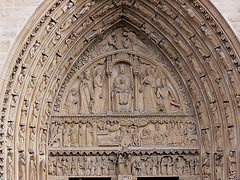 The portal of St Anne on the right of the western façade was built in 1200 and is the earliest of the three portals to be built. The tympanum is actually dated to about 1150 and was once part of the earlier cathedral of St. Stephen whose western façade was once 40 metres to the west of the present Cathedral.
In the 13th century (c. 1200–1300), church monuments were effigial tombs, cross slabs, and early brasses, emerging as Gothic art replaced Romanesque. They focused on piety, feudal status, and intercession, with stiff, symbolic figures.
Tomb of Eleanor of Aquitaine (d1204) at Fontevraud Abbey in France. Eleanor was first married to Louis VII of France, and had two daughters by him. However, they divorced in March, and in May of the same year, she married Henry of Anjou the future Henry II of England

Bishop of Worcester 1218-1236. The effigy on the tomb is in the Romanesque style and lacks the detailed modelling that would become the hallmark of Gothic sculpture.

This finely carved coffin lid features a long-stemmed cross whose arms terminate in deeply incised, curling foliage, a design symbolising both the Cross of Christ and the Tree of Life. The leafy ornament, known as a foliated cross, became popular in the 13th century and is often associated with clerical burials or those of prominent parishioners.

Sequence of 13th century wall painting from the in the nave of St. Albans Cathedral show scenes from the life of the Virgin Mary.

A common subject painted in medieval churches where scenes of the "Last Judgment" or "Doom". Often they would be painted above the chancel arch. A central figure of risen Christ with the instruments of the passion would be painted, or a crucifixion with the Virgin Mary and St John the Evangelist.
