
Index of Medieval Sculpture
This tomb of William I Duke of Normandy (d942) in Rouen Cathedral dates from the 14th century. The earlier burial had been in the ancient sanctuary near the end of what is now the nave.

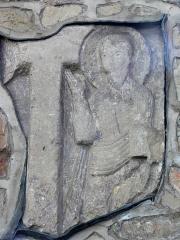
Fragment of saint giving a blessing.
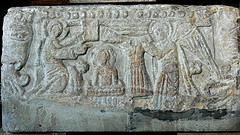
Discovered in 1887 this C12 square bowled font has carved scenes from the life of Crist on all four sides.
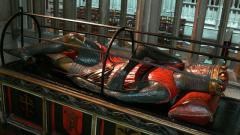
Robert Curthose (d1134) effigy, of painted Irish bog oak, was made about 100 years after his death.
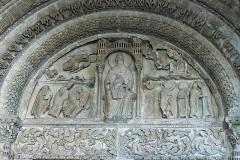
The north portal of Bourges Cathedral is dedicated to the Virgin Mary. The Tympanum dates from between 1160 and was part of the older church the the Gothic cathedral replaced. This portal suffered a lot of damage during the Wars of Religion in 1562.
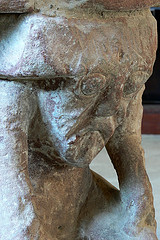
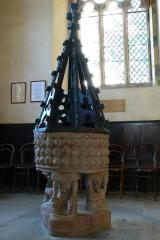
This C12 font has a circular bowl with a bead decoration which is supported by three crouching Atlas figures supporting the red sandstone bowl.
The Gothic period is characterized by the early simplicity of naturalistic figures to the late excessively enriched elegance and elaborate clothing of the figures in the later period, the subject matter of Gothic sculpture featured the mysticism of the mid to late medieval age with an emphasis on suffering and emotion.
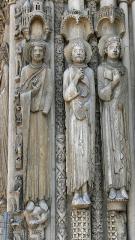
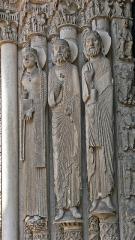
Since its construction in around 1150, the western portal of Chartres Cathedral, decorated with elongated late Romanesque style figures of the Kings and Queens of the Old Testament has been known as the Royal Portal.
 ,
, 
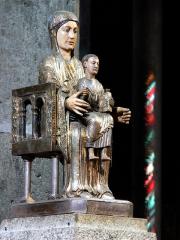
In form and iconography, the statue is closely modelled on the celebrated “Golden Virgin” commissioned by the Bishop of Clermont in 946, a cult image that was destroyed during the Revolution when it was melted down for coinage. On stylistic and material grounds, the Orcival Virgin is now dated to c. 1170, making it a later but faithful reinterpretation of the earlier episcopal image.
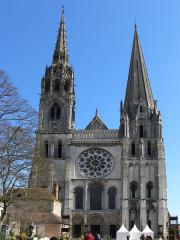
Designated a World heritage Site by UNESCO in 1979 the Cathedral of Notre-Dame de Chartres was built from between 1145 and 1250. It's high nave is spanned by ogival pointed arches to form the vault, and the walls are supported by double flying buttresses. Chartres is the first building to have used buttresses as a structural element.
Chartres Cathedral is also unique in having retained almost all of its original 12th and 13th century stained glass.

The south porch of Chartres Cathedral contains a series of sculptures, that were made between 1194 and 1230, on the subject of the martyrdom of saints.

In addition to the martyrs, the south porch contains a sequence of images of those that had proclaimed Christian beliefs during periods of suppression (confessors).
Tomb of Richard I of England (d1199). This is one of three tombs to Richard I, this one is said to contain his heart, his entrails were buried in Châlus (where he died), and the rest of his body was buried at the feet of his father, Henry II, at Fontevraud Abbey in Anjou.

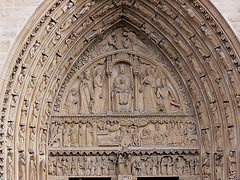 The portal of St Anne on the right of the western façade was built in 1200 and is the earliest of the three portals to be built. The tympanum is actually dated to about 1150 and was once part of the earlier cathedral of St. Stephen whose western façade was once 40 metres to the west of the present Cathedral.
Tomb of Henry the Young King (d1183) son of Henry II of England and Eleanor of Aquitaine, brother of King Richard I of England and King John.
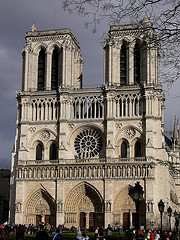
The western façade of the cathedral of Notre-Dame in Paris, with its twin towers, was built between 1200 and 1240. With its three portals containing scenes from the life of the Virgin Mary, the Last Judgment, and scenes from the life of St. Anne, it is considered one of the finest examples of early Gothic architecture.
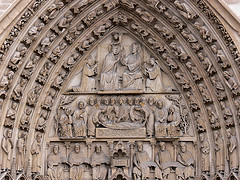 This portal of the Virgin, at Notre Dame Paris, was sculpted between 1210 and 1220. The main scene show the Coronation of the Virgin, where Mary is being crowned Queen of heaven by an angel, whilst she sits on the same throne as Jesus. In the lintel below is Mary on her death bed surrounded by Jesus and the twelve aposles, two angels are about to lift her to heaven. In the lower lintel the old testament prophets are holding scrolls prophesying Christ.
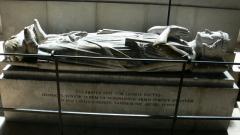
Tomb of King John the youngest son of Henry II and Eleanor of Aquitaine. Made from Purbeck marble the sarcophagus dates from about 1230 and is the earliest effigy in the country to an English king. Originally the effigy would have lain on the floor, but as more elaborate tombs were installed in later years, John's effigy was raised up to rest on a tomb chest that was made in about 1540.

The portal of St Firmin opens into the north aisle of Amiens Cathedral. The tympanum shows the discovery of his remains outside the city, and their transport to the cathedral.

The western facade of the cathedral of Notre-Dame in Amiens contains 3 doorways. A central portal that opens into the nave, and two portals beneath the north and south towers that open into the cathedral's aisles. Above each portal is a tympanum the central one depicting the last Judgement, the northern one the transfer of the relics of St Firmin, and the south portal depicts the Virgin Mary.
