
Index of Medieval Sculpture
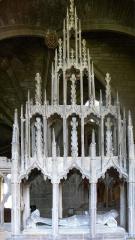
This two storied tomb for Richard de Beauchamp, 1st Earl of Worcester (d1421) was built in 1430 by his wife Lady Isabel le Despenser, the great grand-daughter of Edward III. It was probably meant to contain priant figures of both Richard, Isabel, and her second husband Richard de Beauchamp, 13th Earl of Warwick, who was her first husband's cousin.

The Marmousets Portal Tympanum is a late Gothic sculpture adorning the Porche des Marmousets (Portal of the Marmousets) is the main pedestrian entrance to the Abbey Church of Saint-Ouen in Rouen, Normandy, France. This Flamboyant Gothic portal, primarily honors the Virgin Mary, dates to around 1430 and was crafted by the master sculptor Alexandre de Berneval, and is located at the south transept.
Between 1431 and 1438, the Florentine sculptor Luca della Robbia carved in marble one of the most radiant celebrations of music and childhood in the early Renaissance, the Cantoria, or singing gallery, originally made for the north singing gallery of Florence Cathedral.

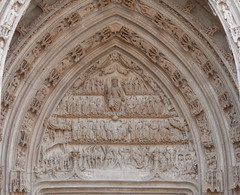
The tympanum above the central porch, of Saint-Maclou in Rouen depicts Christ in Majesty at the Last Judgement in four registers.
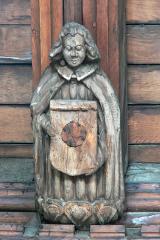
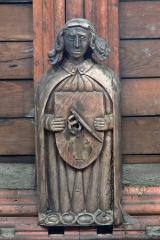
These carved oak Apostles at Dunstable Priory form part of the structural and iconographic programme of the timber roof, functioning as corbels supporting arched braces or hammer-beams. Oak, the standard and most durable timber for English ecclesiastical roofs, was universally favoured for such work, allowing both structural strength and detailed carving.
 ,
, 
Louis of Luxemboug (d1443). Brother of the governor of Paris who sold Joan of Arc to the English.
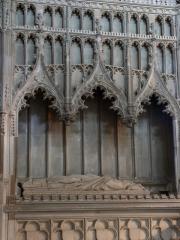
At Yelvertoft Northamptonshire is the tomb of John Dycson, who served as rector of Yelvertoft from 1439 to 1445, is a fine example of 15th-century English funerary art in the Perpendicular Gothic style. The monument consists of an alabaster effigy resting upon a low tomb chest, its sides richly decorated with panels of quatrefoils and other intricate tracery characteristic of the period.
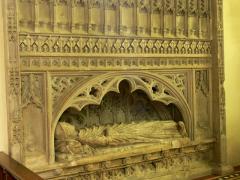
Alabaster tomb of Sir John Cressy (d1445) Dodford, Northamptonshire. The sides of the tomb chest have angels holding shields, and the offices he held in France are listed around the top edge.
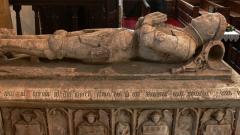
This is the tomb of Richard de Beauchamp, 13th Earl of Warwick. who died at Rouen on the 30th April 1439. His will made an endowment to the collegiate church of St Mary, Warwick, money to build the chantry chapel at St Mary's, and gifts to Tewkesbury Abbey.
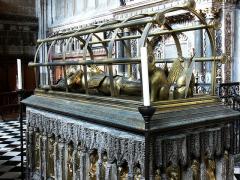
This mid-fifteenth-century effigy depicts a priest shown vested for the celebration of Mass, carved in low relief and set beneath an architectural recess.
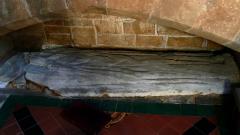
Attributed to John Wakeham (d1549), the last abbot of Tewkesbury, the 'Wakeham' Cenotaph, actually mid fifteenth century and pre-dates the abbot by about 100 years. The effigy is a gisant as a decomposing corpse and the canopy was modelled on the throne of the House of Lords.


This polychromatic stone Holy Sepulchre in the church of Notre-Dame Neufchâtel-en-Bray dates from the mid C15.
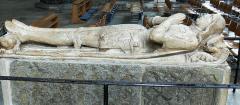
This monument of an alabaster knight wearing Milanese armour is dedicated to Robert Lord Hungerford (d1464).
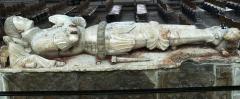
Bishop Ferry de Beauvoir (d1473). Amiens Cathedral France.
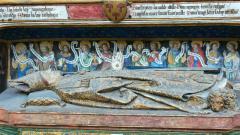
This carved alabaster monument of Bishop John Stanbury contains his effigy and has saints and angels as mourners carrying shields around all sides. Unfortunately the heads of the angels were chipped off during the reformation.
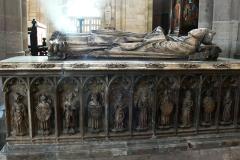

Late Gothic staircase by Guillaume Pontis in 1480, under the direction of cardinal and archbishop William Estouteville. Rouen Cathedral.
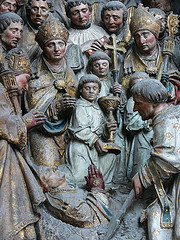
Polychrome reliefs retelling the legend of St Firmin a disciple of St Saturninus of Toulouse, founded the first church in Amiens in the third century.
Lord John Cheney (d1499) was a Lancastrian supporter who in 1483 had supported the Duke of Buckingham's rebellion against Richard III. When Buckingham's rebellion failed he joined Henry Tudor in Brittany and returned with him from France in 1485.

This image shows the Virgin and Child of Chartres Cathedral, commonly known as the Black Madonna of Chartres (Notre-Dame du Pilier). It is one of the most venerated Marian sculptures in France and a central focus of devotion within the cathedral. It was commissioned in 1508 as a black wooden copy of the 13th century silver Madonna that stood on the main altar at Chartres Cathedral.
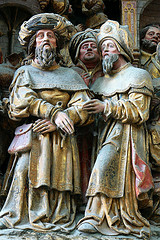
Polychriome reliefs telling the story of St James the Greater, and the conversion of Philetus and Hermogenes. Amiens Cathedral 1511.