Salvator Mundi - Maidford, Northamptonshire
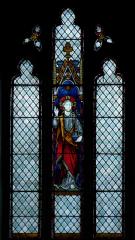
The east window of 1875, made by John Hardman & Co., stands in the church at Maidford. The central light depicts Christ as Salvator Mundi, set within flanking lights of patterned diamond quarries.
The east window of 1875, made by John Hardman & Co., stands in the church at Maidford. The central light depicts Christ as Salvator Mundi, set within flanking lights of patterned diamond quarries.
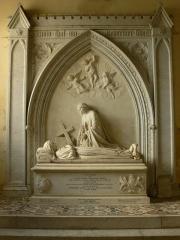
Tomb in memory of Sarah Baroness Braye (d1862) by Mary Thorneycroft ⓘ.
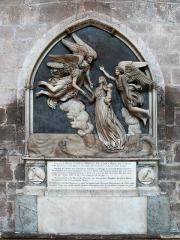
This monument by John Flaxman ⓘ is to Sarah Morley (d1784) who died a few days after giving birth whilst travelling back to England from India. Both Sarah and her child were buried at sea.
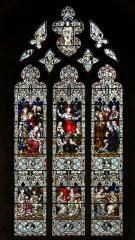
Main panel of this Hardman window illustrates Jesus delivering the Sermon on the Mount.
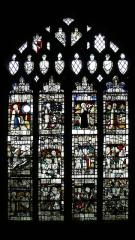
This window in the St Anne Chapel, Malvern Priory, has twelve scenes depicting the Creation story and the Fall. It is dated to between 1440-1450 and was probably the gift of Isabel Despenser and Richard de Beauchamp, 13th earl of Warwick.
The four panels in the top register of the window illustrate the seven days of creation.
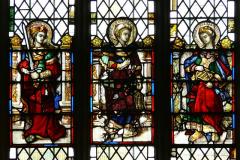
Three Sibyls east window: Persica, Europa, and Samia. St. Peter ⓘ Coughton.
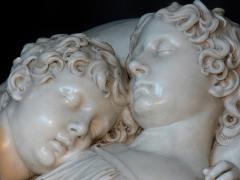
Sculpted from white marble by Sir Frances Chantrey, this memorial is to the two daughters of Ellen-Jane Robinson, Ellen-Jane and Marianne.
Installed in October 1992, these three windows, reflecting on Psalm 148 and John 20:24-29, are located in the South Ambulatory Chapel of Gloucester Cathedral, and are by Tom Denny.
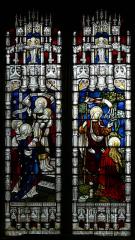
The south window of the chancel at All Saints, Middleton Cheney, contains two important stained-glass panels designed by Ford Madox Brown in 1870, created during his period of work for Morris, Marshall, Faulkner & Co. These windows are among the finest surviving examples of Brown’s contribution to Victorian ecclesiastical glass, characterised by his expressive figures, sculptural modelling, and dense narrative detail.
This two-light window pairs an early-life episode of Christ with a post-Resurrection encounter, creating a deliberate theological contrast between recognition at the Temple and recognition in the garden.
Left-hand light:
The Presentation in the Temple shows the Christ Child received by Simeon, whose gesture and inscription articulate fulfilment and prophecy. The figures are tightly grouped beneath an elaborate Gothic canopy, emphasising the Temple setting and the moment of recognition as Christ is identified as the promised Messiah.