
Raising the Widow's Son - Tewkesbury Abbey
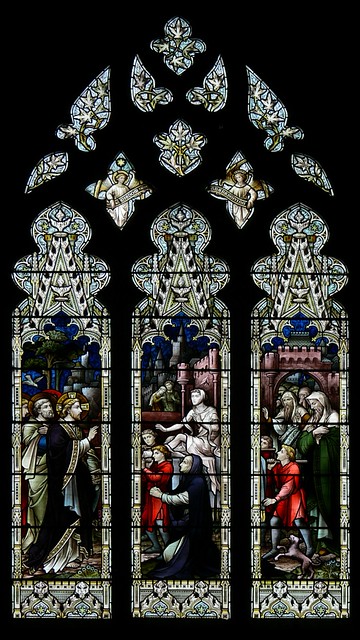
This 1888 window by Hardman & Co. is a characteristic example of the firm’s mature Gothic Revival narrative style, in which theological clarity, strong draughtsmanship, and ornamental consistency are deliberately combined. The overall design follows the fully medievalising idiom favoured in late 19th-century church glazing, yet it also shows the subtler, more painterly tendencies emerging in Hardman’s work of the 1880s.
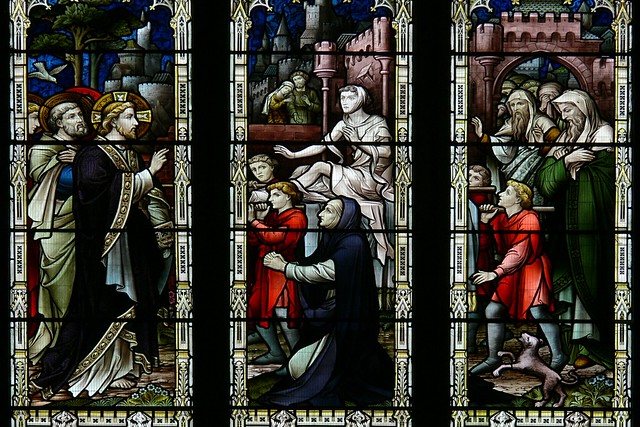
Composition and Narrative Handling
The miracle is arranged across three lights in a left-to-right sequence that respects Gothic panel conventions while allowing the action to unfold fluidly. Hardman’s designers adopt a carefully tiered structure: the principal figures occupy the lower register, the city walls of Nain form a middle band, and the canopy and tracery lights provide a celestial counterpart above.
The narrative pivot, the widow’s son rising from the bier, is placed centrally, ensuring the viewer’s eye is drawn immediately to the miracle. Christ’s advancing gesture and the widow’s kneeling posture create a diagonal movement that lends coherence to all three lights.
Figure Style
The figures display the typical Hardman balance between medieval stylisation and Victorian naturalism. Drapery is sharply pleated and controlled, particularly in Christ’s garments, echoing 14th-century models. At the same time, faces are more expressively modelled than in Hardman’s earlier, more rigid work; the widow’s grief and astonishment are sensitively conveyed, and the bearers’ reactions vary from reverence to disbelief.
The firm’s fondness for elongated proportions is evident, but softened by a more grounded stance and fuller modelling, which reflects an 1880s shift toward pictorial depth.
Colour and Glasswork
The palette combines deep cobalt blues, wine-reds, and olive greens, all characteristic of Hardman glazing. These saturated tones are used not only for aesthetic richness but for structural emphasis: the red garments of the attendants anchor the composition, while Christ’s blue-and-white robes provide contrast and draw attention to His central role.
Backgrounds employ a mixture of painted detail and flashed glass, with the stonework of Nain’s gates and battlements rendered in subdued pinkish tones, preventing them from competing with the figures.
Architectural and Decorative Framework
The canopies above the narrative follow geometric Gothic forms, intricately laced with vegetal and architectural motifs. These, together with the patterned borders, create a strong medievalising frame.
In the tracery lights, two angels display scrolls inscribed Wisdom and Thanksgiving. Their pale, luminous robes and the looser, more celestial colouring of the background distinguish the heavenly realm from the earthly drama below. The angels’ restrained expressions and elegantly raised wings reflect the Hardman studio’s disciplined, liturgical aesthetic.
Overall Effect
As a whole, the window demonstrates Hardman & Co.’s ability to combine medieval correctness with Victorian expressiveness. The scene is theologically precise, visually coherent, and emotionally legible, achieving the firm’s aim of providing stained glass that serves both devotion and instruction. The window sits comfortably within the wider programme of late-19th-century glazing at Tewkesbury Abbey, yet it also shows the subtle refinements that mark Hardman’s later period, richer modelling, more sensitive expressions, and a controlled but increasingly painterly use of colour.
