
Millennium windows
Commission and context
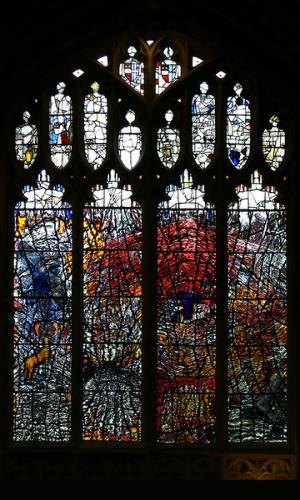
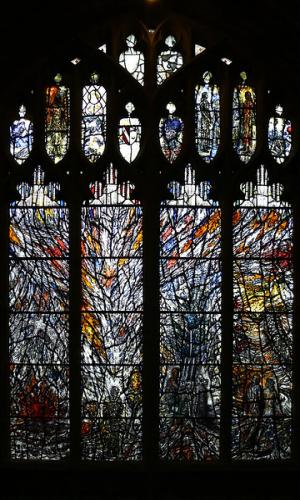
In 2003, two stained-glass windows designed by Tom Denny were installed in Great Malvern Priory as a millennium commission. The windows form part of Denny’s wider body of ecclesiastical work, characterised by a contemporary visual language developed in close dialogue with medieval architecture, light, and devotional tradition.
At Malvern, the commission responds directly to the scale and luminosity of the priory interior and to the presence of an extensive surviving medieval glazing programme. Rather than competing with the fifteenth-century glass, Denny’s windows establish a modern counterpart that is contemplative in tone and restrained in colour, allowing the historic fabric to remain visually dominant.
→ Great Malvern Priory – Stained Glass
Iconographic programme: Psalm 36
The imagery of the Millennium Windows is structured around Psalm 36, a text that moves from an opening meditation on human transgression to an affirmation of divine mercy, righteousness, and sustaining light. Denny does not attempt a literal illustration of the psalm. Instead, its themes are translated into an abstract visual language that unfolds across the paired windows.
The darker opening verses of the psalm, which address pride, deceit, and moral blindness, inform passages of denser colour and compressed form. These are counterbalanced by lighter, more expansive fields that correspond to the psalm’s central affirmations of divine mercy and faithfulness, expressed in metaphors of height, depth, and flowing abundance. The concluding emphasis on light — “in thy light shall we see light” — finds expression in the windows’ increasing luminosity and openness, guiding the viewer’s eye and movement through the space.
This progression from shadow to illumination mirrors both the internal logic of the psalm and the physical experience of light within the church.
Relationship to the medieval setting
Denny’s design consciously avoids figural representation, allowing colour, rhythm, and spatial structure to carry meaning. This approach enables the windows to coexist with the priory’s medieval stained glass without visual or iconographic conflict. The abstraction also invites sustained contemplation, aligning the modern commission with long-standing devotional uses of stained glass rather than presenting it as a purely decorative intervention.
Within the context of Great Malvern Priory, the Millennium Windows form a rare example of a contemporary glazing scheme that engages thoughtfully with a historic interior while maintaining a clearly modern artistic identity.
