
East Window - Crick Northamptonshire
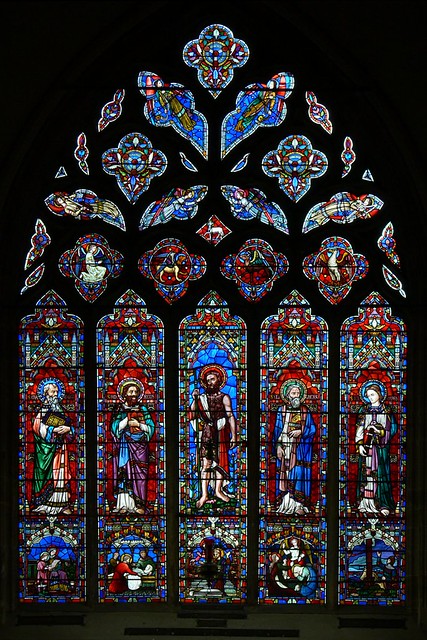
The east window of the parish church of St Margaret, Crick, is a large multi-light stained-glass composition dated 1857, by Lavers & Barraud1, and predates the appointment of Nathaniel Westlake as principal designer at the firm. Occupying the principal liturgical position, the window presents a carefully structured theological programme combining figures of prophecy, witness, and redemption.
Description and iconography
The main lights are arranged around a dominant central figure of St John the Baptist, shown as the forerunner of Christ and the final prophet of the Old Covenant. He occupies the axial position of the window, reinforcing his theological role as the bridge between prophecy and fulfilment.
Flanking the central light are the Four Evangelists, each identifiable by their traditional attributes. Their inclusion emphasises the authority of the Gospel witness and frames the Baptist within the written testimony of the New Testament. The figures are set beneath tall Gothic canopies, creating a unified architectural rhythm across the window.
The predella contains a sequence of smaller narrative scenes drawn from the life of Christ and the Virgin:
-
The Virgin learning to read, an image of instruction and preparation, associated with Marian devotion and wisdom.
-
Christ raising the daughter of Jairus, representing divine power over death.
-
Christ preaching, emphasising teaching and revelation.
-
The Resurrection, affirming triumph over death and the promise of salvation.
-
An unidentified scene, now difficult to interpret with certainty, possibly owing to restoration, alteration, or loss of detail.
Together, these lower scenes reinforce the salvific themes articulated in the upper register, moving from instruction and miracle to proclamation and resurrection.
Style and context
Dated 1857, the window belongs to the early mature phase of Lavers & Barraud’s production, when the firm was establishing itself as a leading supplier of ecclesiastical stained glass. The design combines clear figure drawing with strong but controlled colour, set within a disciplined Gothic framework. Narrative clarity and legibility at distance are prioritised, in keeping with mid-Victorian liturgical expectations.
Within the context of Northamptonshire stained glass, the Crick east window represents an ambitious and coherent early commission, illustrating both the theological breadth and compositional confidence of the Lavers & Barraud studio in the mid-nineteenth century.
Significance
The identification of the window’s date and attribution resolves a long-standing uncertainty and allows it to be situated securely within the development of Victorian stained glass in the county. As an early, well-documented work, it contributes significantly to the understanding of Lavers & Barraud’s formative ecclesiastical output.