
Saints and the Te Deum - Stamford, Lincolnshire
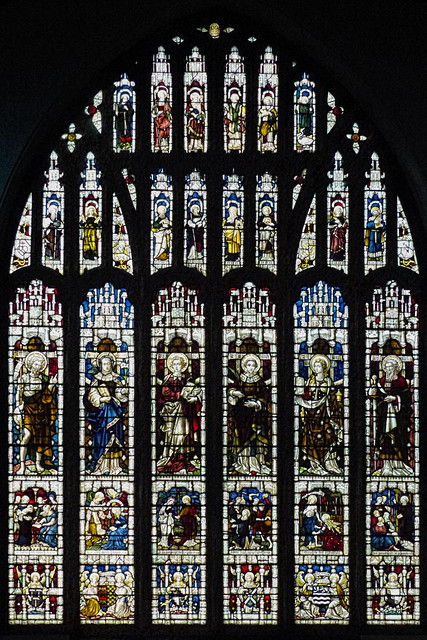
This monumental six-light west window, installed in 1888, was executed by Clayton & Bell ⓘ and commissioned by Edward Ingersoll Browne of Boston, Massachusetts, in memory of Charles Browne, descendant of the fifteenth-century Browne family of Stamford. It consciously recalls the Browne family’s late medieval patronage of the church.
The programme follows a hierarchical structure consistent with the hymn Te Deum laudamus, uniting angels, prophets, saints, and narrative scenes in a vertical theological progression.
Main Lights (Left to Right)
-
St John the Baptist ⓘ
Predella: Zacharias writing the name “John”, affirming the angelic prophecy (Luke 1:63). -
The Virgin Mary ⓘ
Predella: The Annunciation, the angel Gabriel announcing the Incarnation. -
St John the Evangelist ⓘ
Predella: John leading the Virgin away from the Crucifixion, her face marked by visible tears — a poignant and finely observed detail. -
St Stephen ⓘ
Predella: The Martyrdom of St Stephen, shown being stoned (Acts 7). -
Mary Magdalene ⓘ
Predella: The encounter with the risen Christ in the garden (“Noli me tangere”). -
St Paul ⓘ
Predella: St Paul preaching, representing apostolic mission and doctrinal proclamation.
The sequence moves from prophecy and Incarnation through martyrdom and Resurrection to apostolic teaching, visually expressing the Church’s foundation and witness.
Tracery
The upper tracery contains prophets and angelic figures, reinforcing the celestial dimension of the Te Deum theme.
Lower Tier
Angels hold heraldic shields representing:
-
The Browne family
-
The Borough of Stamford
-
The Staple of Calais
These emblems connect medieval patronage with nineteenth-century commemoration.
Style
The window exemplifies High Victorian Gothic Revival. Clayton & Bell’s characteristic architectural canopies, clear figure drawing, and luminous yet balanced colour palette are evident throughout. The narrative predella scenes demonstrate the studio’s refined storytelling, including subtle emotional detail visible even at considerable height.
