
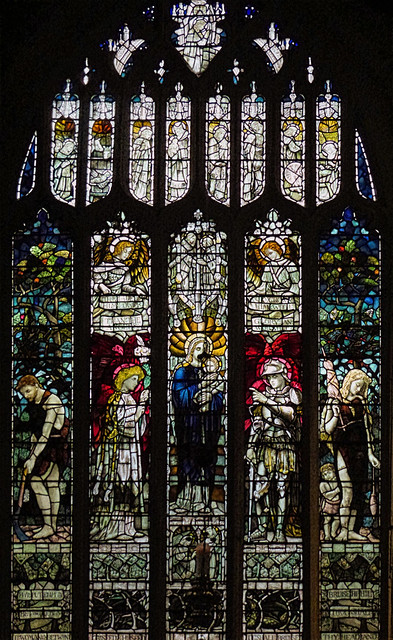
This multi-light window of 1891, designed by Christopher Whall, presents a carefully structured theological programme articulated through an early and ambitious example of his independent Arts and Crafts work. Executed shortly after his departure from the Whitefriars studio of J. Powell & Sons, it stands among his first major ecclesiastical commissions undertaken in his own name.
The outer lights depict Adam and Eve amid dense foliage. Adam holds a spade, emblem of labour after the Fall, while Eve carries a spindle, symbolising domestic toil. Beneath them runs the text from Genesis 3:15:
“I will put enmity between thee and the woman…
it shall bruise thy head, and thou shalt bruise his heel.”
This verse, traditionally known as the Protoevangelium, announces redemption at the very moment of humanity’s fall. Whall thus begins not with temptation but with promise.
The inner lights move into fulfilment. Below the central figures appears the Annunciation, while above is the Visitation, framing the central image of the Virgin and Child. The Incarnation stands at the heart of the composition as the answer to Genesis.
Flanking the Virgin are the archangels:
-
Gabriel, messenger of the Annunciation
-
St Michael, defender against evil
Above them are inscriptions from Psalm 8:5:
“Thou madest him lower than the angels”
“To crown him with glory and honour”
The psalm, interpreted Christologically in Hebrews 2:7–9, forms a theological hinge: humanity humbled, yet destined for exaltation. The Fall, the Incarnation, and the restoration of glory are held in a single scriptural arc.
In the tracery above appears the Coronation of the Virgin, completing the sequence from Fall (Genesis), through Redemption (Incarnation), to Glorification (Psalm 8 fulfilled).
Stylistically, the window reveals Whall’s emerging mature manner: expressive lead lines functioning as active drawing, richly textured colour, and figures integrated with their vegetal surroundings. Compared with mid-Victorian academic glazing, the treatment is freer and more unified, marking a decisive step toward the fully developed Arts and Crafts aesthetic.
The programme is therefore not merely Marian but profoundly theological: from the promise of Genesis to the exaltation of redeemed humanity.
