Medieval stained glass
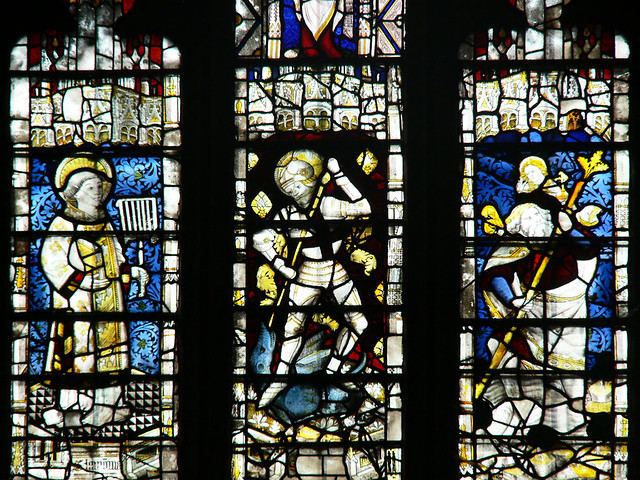
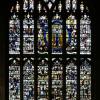
A substantial body of medieval stained glass survives at Great Malvern Priory, although its condition and completeness vary considerably from window to window. Several major fifteenth-century windows remain largely intact, most notably the Magnificat Window, the Founder’s Window, and the glazing of the Lady Chapel. Elsewhere, survival is more fragmentary: the great east window, though once a dominant feature of the church, now survives largely in dispersed panels and fragments rather than as a complete scheme.
For a detailed catalogue of the medieval stained glass at Malvern within the wider English context, see Malvern Priory (English medieval stained glass).
The original glazing programme of the priory’s east end, including the great east window, has long been associated on stylistic grounds with the workshop of John Thornton of Coventry, the master glazier responsible for the Great East Window of York Minster (contracted in 1405). While no documentary contract for Malvern survives, the scale, ambition, and quality of the lost east window make such an attribution plausible, particularly in light of known patterns of elite patronage and workshop activity in the early fifteenth century.
The great east window was almost certainly funded by Isabella Despenser and Richard Beauchamp, Earl of Warwick, whose patronage played a central role in the rebuilding and embellishment of the priory at this time. Their involvement places the glazing programme firmly within the context of high-status aristocratic commissions comparable to contemporary work elsewhere in England.
The windows of the Lady Chapel may also be associated with Isabella Despenser, who is known to have financed the reconstruction of the priory’s east end and quire. The iconographic programme of the Lady Chapel glazing aligns closely with devotional themes favoured by the Beauchamp–Despenser circle. However, in the absence of direct documentary evidence, the attribution of their commission to Isabella Despenser must remain probable rather than certain.
The Magnificat Window is attributed by the Corpus Vitrearum Medii Aevi ⓘ (CVMA) to glaziers working within the circle of William Twygge and Thomas Woodshawe, based on close stylistic comparisons with the east windows at Tattershall, a securely documented commission of the later fifteenth century. These comparisons rest on shared figure types, compositional strategies, and handling of drapery and architectural canopies, and place the Malvern window within a group of high-quality works associated with court-connected glazing workshops active during the reign of Edward IV.
By contrast, the Founder’s Window belongs to an earlier phase of the priory’s glazing and predates the Yorkist period. It was probably produced at roughly the same time as the Lady Chapel windows and is best understood as the work of regional workshops operating in the Worcester–Hereford area, rather than of a centrally organised royal atelier. Its narrative focus on the foundation legend of the priory reflects local devotional priorities and distinguishes it from the more overtly courtly character of later fifteenth-century glazing at Malvern.