
Good Samaritan - Market Bosworth Leicestershire
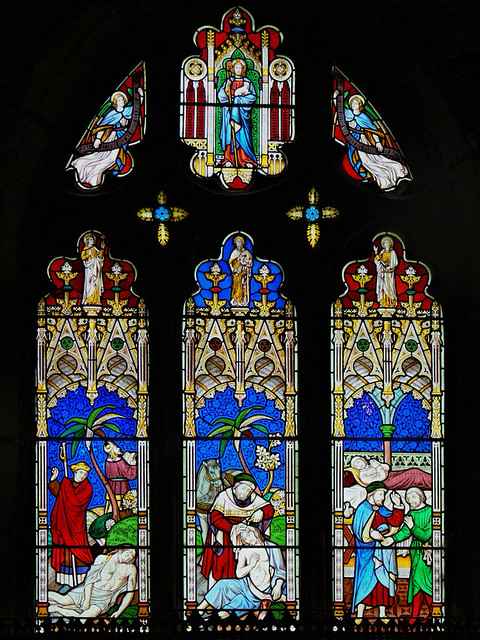
This vibrant Victorian stained glass window, created by the prolific English glass painter William Wailes (1808–1881) around 1850–1860,1 is located in the east window of the south aisle at St. Peter ⓘ and St. Mary's Church in Market Bosworth, Leicestershire, England. Wailes, founder of one of Britain's largest stained glass studios in Newcastle upon Tyne, was renowned for his High Victorian Gothic Revival style, blending medieval-inspired tracery with narrative clarity and jewel-toned colors achieved through pot-metal glass techniques. Commissioned during the Gothic Revival's peak, the window illustrates the Parable of the Good Samaritan (Luke 10:25–37), emphasizing Christian charity and compassion, themes resonant in 19th-century Anglican moralism.
In the trefoil ⓘ apex, the Good Shepherd serves as a typological crown, linking Christ’s pastoral care to the Samaritan’s mercy. Christ, depicted as a youthful shepherd in a flowing red tunic and blue mantle, stands centrally holding a lamb tenderly in his arms, its white fleece contrasting his golden halo. His serene face, framed by curly hair, gazes downward with compassion, symbolizing protection and sacrifice (John 10:11). Flanking angels in white and rose robes, their wings edged in gold, hover with harps or censers, enhancing the celestial mood. This imagery, rooted in early Christian art, reinforces the theme of salvation, paralleling the Samaritan’s act with Christ’s ultimate redemption.
The three principal lancets depict successive moments from the Parable of the Good Samaritan (Luke 10:25–37), set within stylised biblical landscapes of palms and patterned skies.
In the left-hand lancet, the wounded traveller lies collapsed on the ground beneath a palm tree. Two figures pass him by. The nearer figure, holding a staff, turns away, while the more distant figure appears absorbed in a book or scroll. These are the Levite and the priest, whose deliberate avoidance underscores the moral tension of the parable: religious office without compassion. The traveller’s exposed body and supine posture emphasise vulnerability and abandonment.
In the central lancet, the Good Samaritan kneels beside the injured man, binding his wounds. His donkey stands clearly behind him, reinforcing the Gospel detail. The Samaritan’s posture is protective and attentive, forming the visual and theological centre of the composition. This is the moment of active mercy.
In the right-hand lancet, the narrative concludes inside an architectural setting. The wounded man reclines on a bed while the Samaritan stands beside the innkeeper, handing over payment for his continued care. The exchange of coins makes explicit the Gospel’s closing instruction to “take care of him,” extending charity beyond immediate rescue.
Above, saints and angels occupy the upper register and tracery lights, framing the narrative below within a devotional and doctrinal context. The strong blues, reds, and gold accents unify the three scenes, guiding the eye from neglect, to compassion, to sustained responsibility.
The Good Shepherd upper register, a Victorian reinterpretation of early Christian iconography, aligns with the era’s moral and theological focus, complementing the Samaritan’s earthly kindness with Christ’s divine model.
