
Coronation of the Virgin
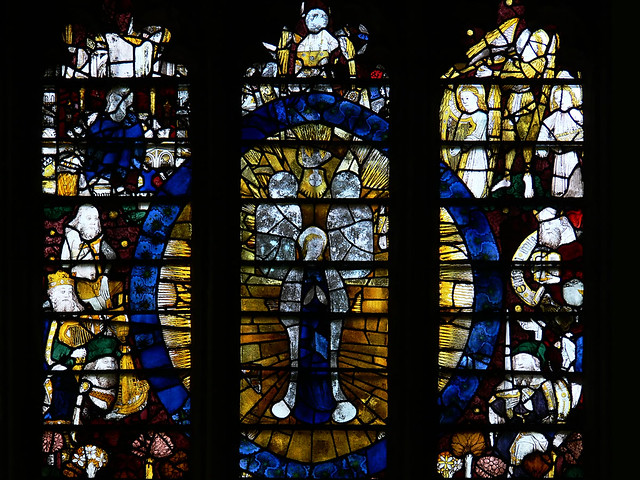
This scene depicting the Coronation of the Virgin forms part of the Magnificat Window of 1501 in the north transept of Great Malvern Priory and extends across three lights, emphasising both its theological importance and its visual prominence within the wider glazing scheme. The subject, drawn from late medieval Marian devotion, celebrates Mary’s exaltation in heaven following her Assumption, a theme closely aligned with the Magnificat’s emphasis on humility rewarded by divine grace.
At the centre of the composition, the Virgin Mary ⓘ stands frontally against a ground of radiant gold, enclosed within a deep blue vesica, a form traditionally used to signify sacred presence and heavenly glory. The vesica acts as a visual threshold between the earthly and the divine, isolating the Virgin in a space of transcendence. Above her, the composition originally included the figures of God the Father and Christ, now lost, whose presence would have completed the Trinitarian framework of the Coronation. The Holy Spirit, represented as a dove, survives above the Virgin’s head, preserving an essential element of the original iconography.
Flanking the central vesica are standing figures drawn from the Old Testament and sacred history, arranged to articulate the continuity between the Old and New Covenants. To the left, Adam, identifiable by his spade, appears as the progenitor of humanity whose fall necessitated redemption, while King David ⓘ, holding a lyre, represents both royal ancestry and prophetic foreshadowing of Christ. Their placement underscores Mary’s role within salvation history, linking the Fall to its redemptive fulfilment.
On the right-hand side, a group of angels, one prominently playing a harp, occupy the upper register, reinforcing the heavenly setting of the Coronation. Below them stands Moses, traditionally shown as the bearer of the Law, followed by a damaged or incomplete figure, whose identity is now uncertain due to loss. At the base appears Abraham ⓘ, carrying a sword, an allusion to sacrifice and obedience, and a further reminder of the patriarchal lineage leading to the Incarnation.
Despite losses and fragmentation, the composition remains legible and expressive. The strong contrast between the shimmering gold ground and the saturated blues of the vesica, combined with the animated gestures and attributes of the surrounding figures, reflects the richness and confidence of late medieval English stained glass at the turn of the 16th century. The scene functions both as a theological statement and as a visual climax within the Magnificat Window, affirming Mary’s exalted status while situating her within the broader narrative of biblical history.
As a surviving component of a royal commission given by Henry VII, this Coronation scene retains particular historical and devotional significance. Even in its incomplete state, it conveys the ambition of the original programme and the sophistication with which medieval glaziers integrated doctrine, symbolism, and visual splendour into a unified monumental design.
