
The south wall of the chancel at Guilsborough contains a sequence of four lancet windows designed by Edward Burne-Jones ⓘ and executed by Morris & Co. They were installed as a memorial to Countess Adelaide Spencer (1825–77), great-great-grandmother of Diana, Princess of Wales.
Burne-Jones’s own account book for December 1878 records the commission under the entry:
“More Jews vis Guilsborough … £40.”
This humorous shorthand refers to the Old Testament and New Testament Jewish figures depicted across the four lights.

Rachel, Wife of Jacob
Rachel is shown carrying a water-jar, dressed in layered drapery of green and gold. The design is typical of Burne-Jones’s elegant early mature period, with elongated proportions and rhythmic lines. The inscription names her: Rachel Uxor Jacob.
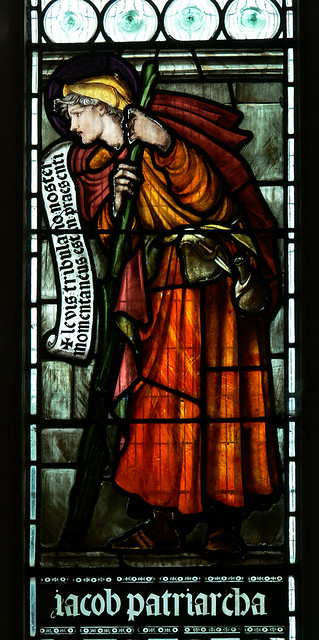
Jacob, Patriarch
Jacob appears as a traveller carrying a staff and bundle, rendered in warm russet and ochre tones. His pose and flowing drapery reflect Burne-Jones’s interest in Quattrocento figure types. A scroll beside him bears part of a Latin text.


Lazarus, Friend of Christ
Lazarus is shown emerging from the tomb, still wrapped in grave clothes. Burne-Jones uses stark white and grey glass to heighten the sense of resurrection. The inscription identifies him: Lazarus Amicus Christi.
Mary of Bethany (Maria Soror Eius)
Mary, sister of Lazarus, appears in flowing robes of white and gold, her head bowed in contemplation. Her figure forms a visual pair with Lazarus, echoing his pose but rendered with greater softness and grace.
Ground and Inscription Panels
Each lancet stands above plain quarry tiles, with the dedication to Adelaide Spencer running along the base, linking the four windows into a unified memorial scheme.
Significance
These windows form one of the most refined Burne-Jones ensembles in a rural Northamptonshire church. Their restrained colour palette, architectural simplicity, and expressive figuration mark them as characteristic works of his late 1870s style, and they remain a key component of Guilsborough’s important group of Morris & Co. furnishings.
