Window w.206 forms part of the major early 13th-century glazing programme of the choir clerestory at Bourges Cathedral. Like the other apostolic lancets in this zone, it presents three full-length apostles standing beneath architectural canopies, each framed by the characteristic red–blue geometric borders of the Bourges workshop. The style, palette, and facial types align closely with the glazing campaigns dated to c.1210–1215.
Index of Medieval all
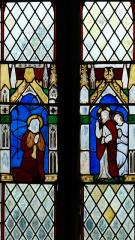
Window 204 consists of two tall lancets forming part of the celebrated early thirteenth-century clerestory glazing of Bourges Cathedral. The saints represented, Andrew on the left and John the Evangelist on the right, are shown as full-height standing figures beneath architectural canopies, framed by the characteristic geometric borders of the Bourges workshop.
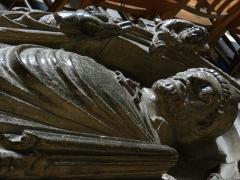
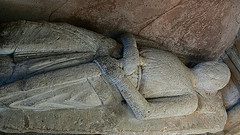
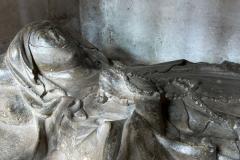
Tomb of King John the youngest son of Henry II and Eleanor of Aquitaine. Made from Purbeck marble the sarcophagus dates from about 1230 and is the earliest effigy in the country to an English king. Originally the effigy would have lain on the floor, but as more elaborate tombs were installed in later years, John's effigy was raised up to rest on a tomb chest that was made in about 1540.
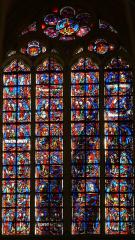
Donated by Thibault VI count of Chartres, in 1217, on behalf of Thomas count of Perche, this window illustrates the signs of the zodiac on the right hand side of the window, and the labouirs of the months on the left hand side. The four central quatrefoils are split between the months and the zodiac.
The western facade of the cathedral of Notre-Dame in Amiens contains 3 doorways. A central portal that opens into the nave, and two portals beneath the north and south towers that open into the cathedral's aisles. Above each portal is a tympanum the central one depicting the last Judgement, the northern one the transfer of the relics of St Firmin, and the south portal depicts the Virgin Mary.