
Transfiguration - Tewkesbury Abbey
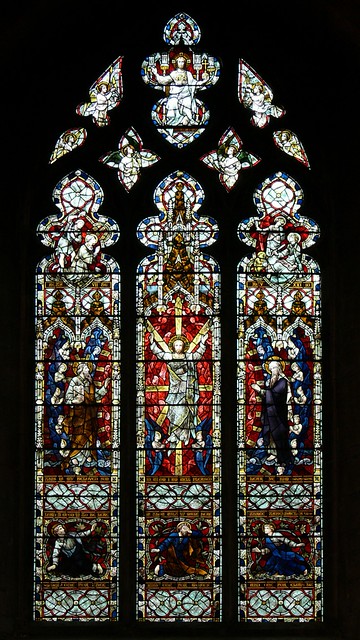
This richly coloured late-Victorian window by Hardman & Co. (1892) depicts the Transfiguration of Christ on Mount Tabor, one of the most important theophanies in the New Testament (Matthew 17:1–9; Mark 9:2–8; Luke 9:28–36).
Upper Panels
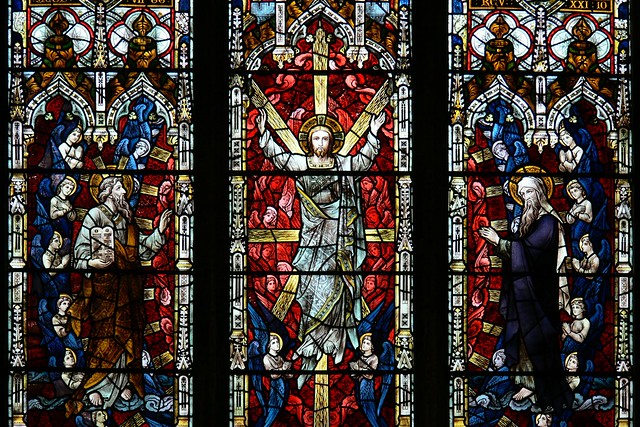
In the central light, Christ stands radiant within a mandorla of golden light, flanked by adoring angels. His pose is one of calm authority, his garments glowing white in reference to the Gospel descriptions of the Transfiguration.
To either side stand the Old Testament prophets:
-
Left: Moses, recognisable by the Tablets of the Law, addressing Christ as the fulfilment of the covenant.
-
Right: Elijah, the eschatological prophet, raising his hand in prophetic testimony.
Above the prophets, two typological scenes reinforce the theme of divine revelation:
-
Above Moses: The Stoning of St Stephen ⓘ, the first Christian martyr, whose vision of Christ in glory mirrors the disciples’ experience.
-
Above Elijah: St John’s ⓘ Vision of the New Jerusalem, emphasising Christ’s glory revealed at the end of time.
Inscription (Upper Register)
“THIS IS MY BELOVED SON — IN WHOM I AM WELL PLEASED — HEAR YE HIM.”
The words spoken by the heavenly voice during the Transfiguration.
Lower Panels

At the foot of the window are the three disciples who accompanied Christ:
-
Peter (left), thrown backwards in astonishment
-
James (centre), kneeling and shielding his face
-
John (right), turning in awe toward the vision
Together they embody the human reaction to divine revelation: fear, wonder, and devotion.
Inscription (Lower Register)
"LORD IT IS GOOD FOR US TO BE HERE — IF THOU WILT LET US MAKE HERE — THREE TABERNACLES — ONE FOR THEE — ONE FOR MOSES — AND ONE FOR ELIAS."
Which was Peter’s impulsive response to the vision (Matthew 17:4).
Commentary
Hardman’s 1892 window is a consummate example of the firm’s late Gothic Revival style: clear narrative, balanced colour, and densely patterned backgrounds typical of Hardman’s work under J.H. Powell’s later influence. The typological pairing of Stephen and the New Jerusalem underscores Victorian theological interest in linking Old and New Testament revelation to the Church’s future hope.
