Renaissance

The Life of St Austremoine - Abbey Church of Saint-Ouen, Rouen

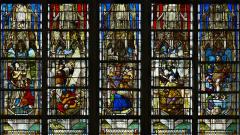
Life of St Austremoine

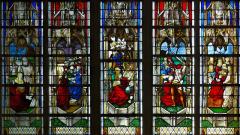
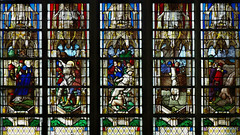
This window forms part of the late-medieval glazing cycle devoted to St Austremoine (St Austremonius), traditionally regarded as one of the missionary bishops sent from Rome to evangelise Gaul. The panels adopt the rich narrative style characteristic of Rouen workshops in the early sixteenth century, combining brightly modelled figures, deep architectural canopies, and landscape backdrops that open the narratives into broad, coherent sequences.


The Life of St Catherine - Abbey Church of Saint-Ouen, Rouen

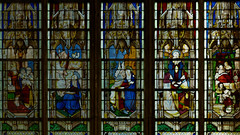
Life of St Catherine

This window (c1508) depicts key moments from the life and martyrdom of St Catherine of Alexandria, a learned noblewoman whose legend was widely celebrated in late-medieval Europe. The glazing, produced by a Rouen workshop in the early sixteenth century, follows the characteristic format of the Saint-Ouen cycles: tightly framed narrative scenes beneath elaborate Gothic canopies, enriched with vivid colour and detailed architectural settings.

The Life of St Vincent - Abbey Church of Saint-Ouen, Rouen

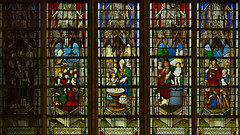
Life of St Vincent

This window (c1550) illustrates episodes from the martyrdom of St Vincent of Saragossa, one of the most widely venerated deacons of the early Church. Created by a Rouen atelier in the early sixteenth century, the glass adopts the familiar layout of the Saint-Ouen narrative series: scenes arranged beneath richly architectural Gothic canopies, each panel presenting a distinct moment from the saint’s Passion.


The Prato pulpit decoration by Donatello

The Prato pulpit decoration by Donatello

The Prato pulpit was commissioned by the Operai del Duomo di Prato for the exterior corner of the cathedral, specifically to display the Sacra Cintola (Holy Belt of the Virgin Mary ), Prato’s most treasured relic.

The South Aisle Nave Windows — Abbey Church of Saint-Ouen, Rouen

The south aisle of the nave at Saint-Ouen preserves one of the most varied yet coherent hagiographic ensembles in the church’s glazing programme. Although the windows today comprise mixtures of sixteenth-century fragments, nineteenth-century architectural refitting, and extensive twentieth-century restoration, they collectively articulate a single, sustained theme: the commemoration of exemplary saints whose lives, virtues, and martyrdoms offered models for Christian devotion.

Touch Me Not (cell 1)

Touch Me Not


This fresco by Fra Angelico in cell 1 of the San Marco Monastery illustrates the encounter between Mary Magdalen and Christ after the ressurection.

Transfiguration (cell 6)


This fresco by Fra Angelico depicts the Transfiguration of Christ, one of the most radiant and spiritually charged scenes in the Gospel narrative. At the center, Christ stands upon a rocky elevation, enveloped in a great mandorla of divine light, his white garments gleaming with celestial brilliance.


Tree of Jesse - Lady Chapel Evreux


This stained glass window in the Lady Chapel of Evreux Cathedral was a given to the cathedral by King Louis XI of France between 1467 and 1469.


Pages

Subscribe to Renaissance