Florence

Historic sites in the city of Florence
Historic sites in the city of Florence
Historic locations in Italy and Sicily.

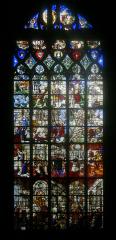
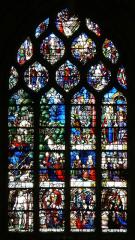
The Lady Chapel at Bourges Cathedral has three stained glass windows from the late 16th century that tell the stories surrounding the Life of the Virgin Mary ⓘ.
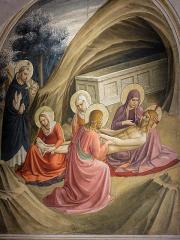
Lamentation (1438-1443) over the body of Christ, is by Fra Angelico ⓘ.
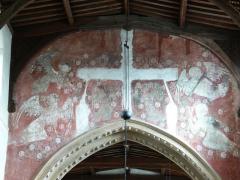
A common subject painted in medieval churches where scenes of the "Last Judgment" or "Doom". Often they would be painted above the chancel arch. A central figure of risen Christ with the instruments of the passion would be painted, or a crucifixion with the Virgin Mary ⓘ and St John the Evangelist ⓘ.
1540 stained glass in St Godard Rouen tell the story of Saint Romain (Romanus).
The stained-glass window illustrating the Legend of St Eustace ⓘ (baie n° 18) in Saint-Étienne ⓘ de Beauvais is a composite Renaissance work, produced in successive campaigns between 1553 and c. 1575. Its extended execution reflects a cumulative process of patronage, bringing together multiple donors, artists, and workshops within a single coherent narrative cycle.
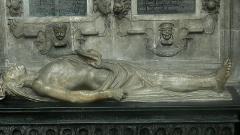
This monument to Louis de Brézé (d1531) is the work of Jean Goujon ⓘ (1510-1572) who was commissioned by Diane de Poitiers, Louis wife. Louis was the son of King Charles VII of France's illegitimate daughter Charlotte de France.
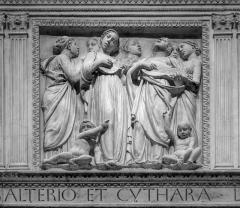
Between 1431 and 1438, the Florentine sculptor Luca della Robbia ⓘ carved in marble one of the most radiant celebrations of music and childhood in the early Renaissance, the Cantoria, or singing gallery, originally made for the north singing gallery of Florence Cathedral.
This glazed terracotta Madonna and Child, executed between 1470 and 1480, is attributed to Andrea della Robbia ⓘ. It reflects the mature style of the della Robbia workshop in the later fifteenth century and demonstrates the devotional clarity and technical refinement that made glazed terracotta one of Florence’s most distinctive artistic media.
The relief is located in the church of San Gaetano.