Gothic

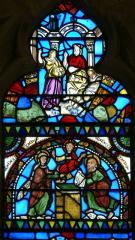
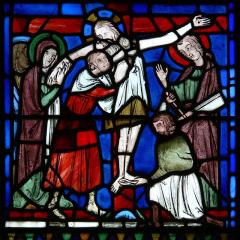
Glass panels from Sainte-Chapelle

Joshua Caleb Spies sainte-chapelle france twycross


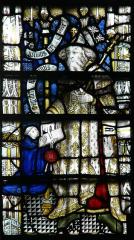
Originally in la Sainte-Chapelle on the Île de la Cité in Paris. This medieval panel (c1245) and others are now in St James Twycross, Leicestershire.


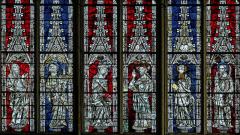
Gloucester Cathedral - East Window

The east window at Gloucester Cathedral was created as part of the rebuilding of the abbey church of St Peter . Built in the Perpendicular style it was the largest window in Europe. The decorative scheme portrays the Coronation of the Virgin and the glass mostly dates from the 1350s.

Gothic Sculpture

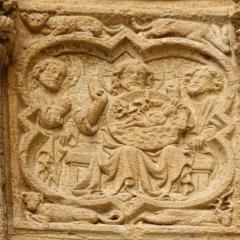
The Gothic period is characterized by the early simplicity of naturalistic figures to the late excessively enriched elegance and elaborate clothing of the figures in the later period, the subject matter of Gothic sculpture featured the mysticism of the mid to late medieval age with an emphasis on suffering and emotion.


Gothic Sculpture in Britain

Gothic sculpture in Britain developed along a distinctive and recognisably insular trajectory between the late twelfth and early sixteenth centuries. Although profoundly indebted to continental models, above all those of northern France, British sculpture was shaped by local traditions, monastic and episcopal patronage, and by a sustained preference for architectural integration and funerary commemoration. The result is a sculptural tradition that is often quieter in emotional register than its French or German counterparts, more linear and pattern-oriented, and deeply embedded in the fabric of churches, tombs, and screens rather than conceived as autonomous statuary.

Gothic Sculpture in France

Gothic Sculpture in France

Gothic sculpture in France occupies a foundational position in the history of medieval art. From the mid-twelfth century onward, French sculptors developed a new figural language closely bound to architecture, theology, and royal ideology. Unlike the more restrained and linear tradition of Britain, French Gothic sculpture is characterised by an early and sustained drive toward monumental naturalism, expressive presence, and narrative clarity, with sculpture conceived as an integral and dominant component of cathedral façades, portals, and interior articulation.

Great Malvern Priory


A substantial body of medieval stained glass survives at Great Malvern Priory, although its condition and completeness vary considerably from window to window. Several major fifteenth-century windows remain largely intact, most notably the Magnificat Window, the Founder’s Window, and the glazing of the Lady Chapel. Elsewhere, survival is more fragmentary: the great east window, though once a dominant feature of the church, now survives largely in dispersed panels and fragments rather than as a complete scheme.


This fifteenth century stained glass panel depicts William the Conqueror, in 1085, giving a charter to the monk Aldwin. It can be found in the north wall clerestory window of the chancel in Great Malvern Priory.


Hugh Despenser the Younger


Stained glass panel (1338-1340) depicting Hugh Despenser the Younger who was married to Eleanor the sister of Gilbert de Clare. Hugh Despenser became the favourite of Edward II but was especially disliked by Queen Isabella, and executed when Edward II was deposed in 1326.


Isaac, Joseph, and Moses


The western most window in the St Anne Chapel, Malvern Priory, has twelve scenes depicting the Story of Isaac, Joseph, and Moses. It is dated to between 1440-1450 and was probably the gift of Isabel Despenser and Richard de Beauchamp, 13th earl of Warwick.


Pages

Subscribe to Gothic