
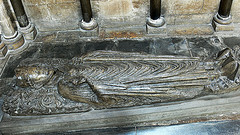
 This mid 13th century tomb of Bishop Walter de Cantelupe (d1266) is made of Purbeck marble. The relief of the effigy is more rounded than that of the nearby tomb of his predecessor the bishop of Worcester William de Blois (d1236) which is still in the Romanesque style and shows the development to the more rounded forms of the early Gothic.
Medieval

This much mutilated, Purbeck marble, effigy is of Bishop Walter de la Wyle at Salisbury Cathedral.
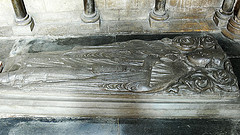 Bishop of Worcester 1218-1236. The effigy on the tomb is in the Romanesque style and lacks the detailed modelling that would become the hallmark of Gothic sculpture.
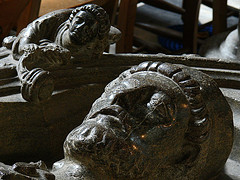
William de Kilkenny (d1256) monument. Bishop of Ely Cambridgeshire.

This image shows the Virgin and Child of Chartres Cathedral, commonly known as the Black Madonna of Chartres (Notre-Dame du Pilier). It is one of the most venerated Marian sculptures in France and a central focus of devotion within the cathedral. It was commissioned in 1508 as a black wooden copy of the 13th century silver Madonna that stood on the main altar at Chartres Cathedral.
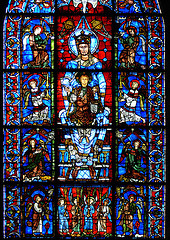
Set into a 13th century window, in the south ambulatory of the choir (bay 44) of Chartres Cathedral, this is one of the most celebrated medieval artworks in the Cathédrale Notre-Dame de Chartres.It dates primarily to c. 1180 CE, with later additions around 1225 CE, making it a rare survivor from the pre-1194 fire that destroyed the earlier Romanesque cathedral.

Late Gothic staircase by Guillaume Pontis in 1480, under the direction of cardinal and archbishop William Estouteville. Rouen Cathedral.

Sculpture of Old Testament stories in the spandrel on the Western facade of Bourges Cathedral.
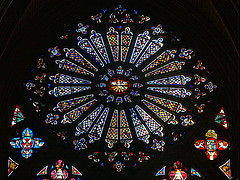 The Cathedral of St Stephen, Bourges contains a large number of medieval and renaissance stained glass. The glass panels date from 1210 - 1620 and represents Saints, Apostles, Prophets, and Bible stories.
The above rose window in the west of the church was built in the last part of 14th century.
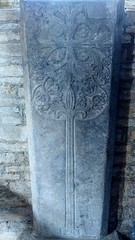
This finely carved coffin lid features a long-stemmed cross whose arms terminate in deeply incised, curling foliage, a design symbolising both the Cross of Christ and the Tree of Life. The leafy ornament, known as a foliated cross, became popular in the 13th century and is often associated with clerical burials or those of prominent parishioners.
Pages
