Legend of Saint Romain - St. Godard
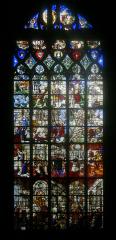
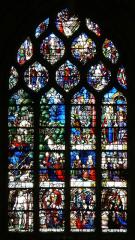
1540 stained glass in St Godard Rouen tell the story of Saint Romain (Romanus).
1540 stained glass in St Godard Rouen tell the story of Saint Romain (Romanus).
The stained-glass window illustrating the Legend of St Eustace ⓘ (baie n° 18) in Saint-Étienne ⓘ de Beauvais is a composite Renaissance work, produced in successive campaigns between 1553 and c. 1575. Its extended execution reflects a cumulative process of patronage, bringing together multiple donors, artists, and workshops within a single coherent narrative cycle.
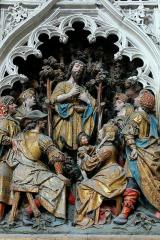
Polychrome reliefs on the north of the choir screen tell the story of the life of John the Baptist ⓘ.
This monument to Louis de Brézé (d1531) is the work of Jean Goujon ⓘ (1510-1572) who was commissioned by Diane de Poitiers, Louis wife. Louis was the son of King Charles VII of France's illegitimate daughter Charlotte de France.
This window in the North transept of Great Malvern Priory was a gift from Henry VII in 1501. Containing scenes from the life of the Virgin Mary ⓘ and the life of Christ., it is known as the Magnificat window because it contains the Song of Mary from Luke 1:46-55.
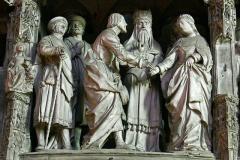
This second sequence of sculpture on the choir screen, starting at the western end of the south ambulatory, is the work of Jehan Soulas from 1520-1535. Sculpted from the hard limestone from the Tonnerre quarry they consist of scenes from the Gospel of James, depicting the marriage of the Virgin Mary ⓘ to Joseph, the annunciation, and the visitation.
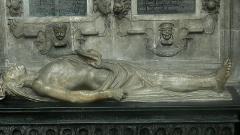
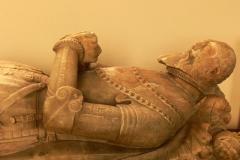
Alabaster tomb effigy of Sir Michael Poulteney (d1567).
This tomb dedicated to Michelangelo was created by Vasari in 1570 and contains elements of Sculpture, Architecture and Painting.

This third sequence of sculpture on the choir screen, starting at the western end of the south ambulatory, is the work of Jehan Soulas from 1521-1535. Sculpted from the hard limestone from the Tonnerre quarry, this consist of scenes depicting the Nativity, Circumcision, and Epiphany.
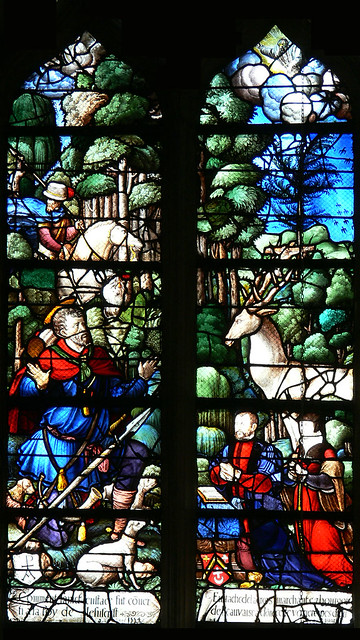
Nicolas Le Prince was a leading Renaissance stained-glass painter active in Beauvais during the mid-16th century. He belonged to the influential Le Prince family of glass painters, whose workshop played a decisive role in the renewal of stained glass in northern France during the first half of the century.