
Index of Victorian all
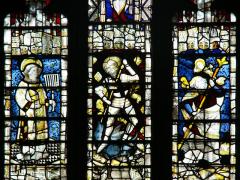
A substantial body of medieval stained glass survives at Great Malvern Priory, although its condition and completeness vary considerably from window to window. Several major fifteenth-century windows remain largely intact, most notably the Magnificat Window, the Founder’s Window, and the glazing of the Lady Chapel. Elsewhere, survival is more fragmentary: the great east window, though once a dominant feature of the church, now survives largely in dispersed panels and fragments rather than as a complete scheme.
Monument to Bishop Joseph Allen (1845).
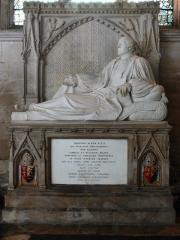
Monument by Richard Westmacott Jr to Robert (d1844) and Sophia (d1849) Otway Cave.
Stained glass by John Hardman in the church of St. Joseph Avon Dassett.

John Hardman windows of 1854 depicting The Annunciation, The Assumption, and St. Stephen.

Six lancet windows, by Hardman and company, in the nave of St Joseph, Avon Dassett, Warwickshire.

This wall memorial tablet commemorates Frederick John Salmon Bagshaw, lieutenant and adjutant of the 36th Regiment, Bengal Native Infantry, who died during the opening phase of the Indian Rebellion of 1857. The tablet is located at Thrapston, Northamptonshire, the parish of which his father, W. S. Bagshaw, was rector.

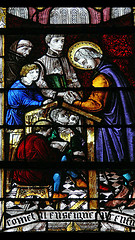
19th century stained glass of St. Leufroy (Leufredus) who was the founder of the Benedictine monastery at La-Croix Saint-Ouen, some 13km from Evreux. Leufroy grew up in Evreux and for a time was a teacher in the town.
This 1860 window by Clayton & Bell depicts the coronation of Henry III in St Peter's Abbey (later cathedral), Gloucester, on the 28th of October 1216. A second coronation was performed at Westminster Abbey on 7th May 1220, Westminster Abbey, because Pope Honorius III did not consider that the first coronation had been conducted properly.

These stained glass windows in the clerestory of Quire at Gloucester Cathedral were made by Clayton and Bell in the early second half of the 19th century. The original medieval clerestory glass had been transferred to fill in damaged panels in other windows in the cathedral notably the great east window and the window in the Lady Chapel.

The earliest stained glass window installed by Hardman, in Worcester Cathedral, is the three light Ressurection window installed in the north aisle in 1861. This eight light west window, however, is one of Hardman's larger works in the UK. Designed by George Gillbert Scott, it was installed in 1875, and depicts the creation.

This three light, Resurrection, window by Hardman and company, was installed in Worcester Cathedral in 1861.

These three stained glass panels, by the Lobin Studio, on the subject of St Helen, are in the Cathedral of the Holy Cross in Orleans, France.
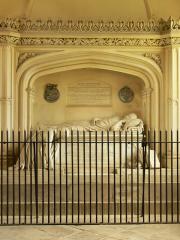
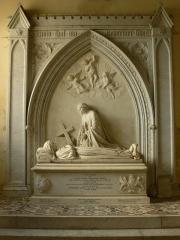
Tomb in memory of Sarah Baroness Braye (d1862) by Mary Thorneycroft.
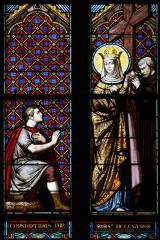
This window by Hardman & Co., illustrates a Salvator Mundi in the typanum, whilst below are three panels depicting St Agnes, The Virgin Mary, and St Dorothy.

This Hardman window from the mid 1860s depicts the resurrection. Christ rises from the tomb with the soldiers on guard recoiling on either side.

A three light Hardman window depicting the three Mary's at the tomb. The central panel shows the angel, whilst the left are Mary, the mother of James, and Mary of Clopas. The right hand panel depicts Mary of Magdalene carrying a vessel of oil.

In the east arcade of the cloisters are two windows depicting the temptation of Christ. These windows were made in the 1860s by John Hardman and Co.

The south aisle west window of Gloucester Cathedral contains this window on the theme of Justice by John Hardman & Co., dated 1865.

Above the Lavatorium at Gloucester Cathedral, these Hardman windows from 1868 depict a number musical angels.
