
Saint Eustace
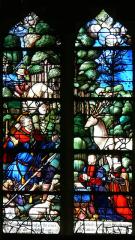
Saint Eustace, also known as Saint Eustache (Latin: Eustachius), is a legendary Roman military commander and Christian martyr, venerated primarily in the medieval Western Church. His cult was widely diffused in France, England, and the Low Countries, where his story was valued for its dramatic narrative structure and moral exemplarity rather than for strict historical verifiability.
Although his historicity is uncertain, Eustace’s legend was firmly established by the early Middle Ages and was included in influential hagiographic compilations such as the Legenda aurea.
The vision of the stag
According to the legend, Eustace was a Roman general named Placidas, serving under the emperor Trajan. While hunting, he pursued a stag which turned to face him, revealing the image of Christ between its antlers. A divine voice called to him, leading to his conversion to Christianity and his baptism, at which point he took the name Eustace.
This moment — the Vision of Saint Eustace ⓘ — became the defining episode of his iconography and one of the most recognisable narrative images in medieval art. It appears frequently in stained glass cycles, where it provided artists with a visually striking and immediately legible scene.
Trials and martyrdom
Following his conversion, Eustace was subjected to a series of trials that echo the biblical Book of Job: loss of wealth, separation from his family, and social ruin. After years of suffering, he was eventually reunited with his wife and sons, only to be martyred together for refusing to sacrifice to pagan gods.
The traditional account places their martyrdom inside a brazen bull, a detail often represented in later medieval imagery and used to emphasise steadfast faith under persecution.
Representation in medieval art
Saint Eustace’s legend lent itself particularly well to narrative cycles, making him a favoured subject for stained glass in the later Middle Ages. His story appears in cathedral and parish church windows, often arranged as sequential scenes beginning with the hunt and concluding with martyrdom.
In France, his cult is especially well represented in sixteenth-century stained glass, including Renaissance windows at Beauvais and elsewhere, where the legend was adapted to contemporary artistic idioms while retaining its medieval narrative structure.
Iconography
Saint Eustace is typically identified by:
-
the stag with a crucifix or Christ’s image between its antlers
-
hunting attire or military dress
-
scenes of familial reunion and martyrdom
These attributes make him immediately recognisable within multi-scene narrative programs.
Significance
While not a historical figure in the modern sense, Saint Eustace occupies an important place in medieval visual culture. His story illustrates how hagiographic legend functioned as a vehicle for moral instruction, emotional engagement, and artistic innovation, particularly within the medium of stained glass.