Scholastica de Gayton - Gayton Northamptonshire

Scholastica de Gayton - Gayton Northamptonshire
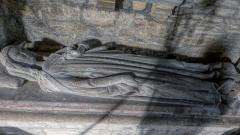
Scholastica de Gayton, who died in 1354, was a member of the medieval de Gayton family, long associated with the village of Gayton in Northamptonshire. She was the daughter of Sir Philip de Gayton, who died in 1316 and whose own effigy also survives in the church of St Mary the Virgin at Gayton.
The Intimate Madonna in Renaissance Florence: Devotion, Tenderness, and the Domestic Image

The Intimate Madonna in Renaissance Florence: Devotion, Tenderness, and the Domestic Image

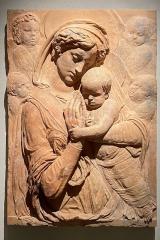
In fifteenth-century Florence, the image of the Virgin and Child underwent a quiet revolution. From the solemn, hieratic figures of late Gothic piety, the Madonna became an image of tender humanity, no longer distant and majestic, but immediate, emotional, and profoundly relatable. This transformation mirrors a broader shift in Renaissance devotion: the movement of sacred experience from church to home, from the grandeur of the altar to the intimacy of domestic life.

The Ospedale degli Innocenti

Swaddled Infant Tondo by Robbia


The Ospedale degli Innocenti in Florence stands at the intersection of art, architecture, and social conscience. Commissioned in 1419 by the Arte della Seta (Silk Guild) and designed by Filippo Brunelleschi , it was both a revolutionary architectural achievement and a profoundly humane institution: the first purpose-built orphanage in Europe.

Dancing Angels: Donatello’s Renaissance Spiritelli

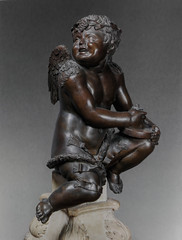
Seated Spritello by Donatello

Donatello’s spiritelli—small bronze, dancing child figures—embody the Renaissance fusion of classical vitality and Christian joy. Created for settings from pulpits to private collections, these lively winged children transformed ancient putti into symbols of divine life and humanist celebration. Through their movement, naturalism, and charm, Donatello redefined sculpture as a living expression of sacred and worldly beauty.

The Prato pulpit decoration by Donatello

The Prato pulpit decoration by Donatello

The Prato pulpit was commissioned by the Operai del Duomo di Prato for the exterior corner of the cathedral, specifically to display the Sacra Cintola (Holy Belt of the Virgin Mary ), Prato’s most treasured relic.

Emmaus Story - Market Bosworth Leicestershire

Emmaus Story - Market Bosworth Leicestershire

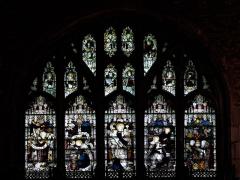
The Emmaus window by Heaton, Butler & Bayne, created in 1925, is a stained-glass triptych set in a South chancel window at Market Bosworth. Made by the London firm known for its Victorian and Pre-Raphaelite style, it depicts the biblical Supper at Emmaus across three panels.

Saints George, Peter, and Margaret - Market Bosworth Leicetershire

Saints George, Peter, and Margaret - Market Bosworth Leicetershire

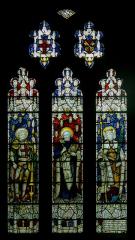
This stained glass window by Charles Eamer Kempe, at St Peter's Market Bosworth Leicestershire, is an example of late Victorian Gothic Revival art, depicting Saints George, Peter, and Margaret in three tall, richly colored panels. Each saint stands beneath an elaborate architectural canopy, rendered in delicate tracery and glowing jewel tones that catch and filter the light with remarkable depth.

Luca della Robbia, Cantoria (1431–1438) - Florence

Luca della Robbia, Cantoria (1431–1438) - Florence

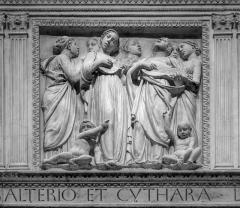
Between 1431 and 1438, the Florentine sculptor Luca della Robbia carved in marble one of the most radiant celebrations of music and childhood in the early Renaissance, the Cantoria, or singing gallery, originally made for the north singing gallery of Florence Cathedral.

Crucifixion - Montresor, France

Crucifixion - Montresor, France

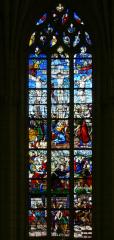
The Crucifixion window in the Church of Saint John the Baptist at Montrésor, in the Indre-et-Loire region of France, is one of the finest surviving examples of early sixteenth-century stained glass in the Loire Valley. Filling a tall Gothic lancet divided into several vertical lights, it unfolds as a vivid narrative of the Passion of Christ, rendered in rich Renaissance color and form.

Pages

Subscribe to Professor Moriarty RSS