Colossi of Memnon

Colossi of Memnon

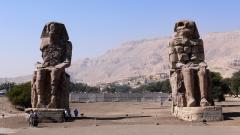
The Colossi of Memnon are two enormous statues that sit on the west bank of the Nile near Luxor, facing east toward the sunrise. Each one shows Pharaoh Amenhotep III seated on a throne, hands resting on his knees, looking out across the river toward the land of the living. They were built around 1350 BCE to stand at the entrance of his mortuary temple, a complex so large it once covered about 35 hectares, bigger than the Temple of Karnak.
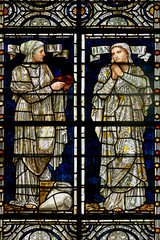
Saints and Patriarchs - Salisbury Cathedral

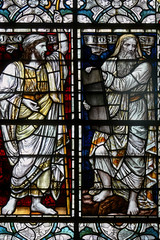
Jacob and Moses


The sequence of stained glass windows depicting the male saints and patriarchs of the Bible, designed by Henry Holiday and made by James Powell & Sons (Whitefriars Glass) in 1891, forms one of the most coherent and dignified ensembles within Salisbury Cathedral’s late Victorian glazing scheme.

Faith, Devotion, and Courage: The Biblical Women of Henry Holiday

Whitefriars Stained glass by Henry Holiday in  Salisbury Cathedral

The four stained glass panels designed by Henry Holiday and made by James Powell & Sons (Whitefriars Glass) in 1891 form one of the most refined and spiritually resonant decorative ensembles in Salisbury Cathedral. Conceived as a unified series, they portray eight women of Scripture, Sarah and Hannah, Mary the Virgin and Mary the Mother of James, Mary of Bethany and Mary Magdalene , and Ruth and Esther, each pair chosen to express a distinct yet harmonizing aspect of faith, devotion, and divine purpose.

Bishop Giles de Bridport Tomb - Salisbury Cathedral

Bishop Giles de Bridport Tomb - Salisbury Cathedral

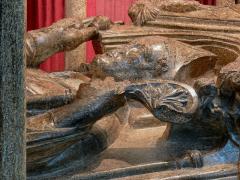
This finely carved effigy represents a 13th-century bishop, shown lying in state with hands raised in prayer. The figure is sculpted from dark Purbeck marble , a material much used in English cathedrals of the period. The bishop is depicted wearing liturgical vestments, including the mitre and chasuble, and rests beneath an elaborately canopied tomb.

The Western Façade of Saint-Maclou, Rouen


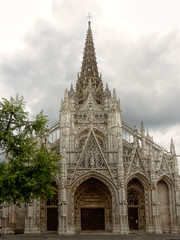
Constructed between 1437 and 1521, the Church of Saint-Maclou occupies a central place in Rouen’s urban and spiritual landscape. The façade, rising before the narrow medieval streets, is one of the most refined expressions of the Flamboyant Gothic, a style characterized by intricate tracery, dynamic ornament, and an almost musical rhythm of line.

Memorial Window to Arthur William Grant - Maidford Northamptonshire

Memorial Window to Arthur William Grant - Maidford Northamptonshire

Situated in the east window of the south aisle, of the church of St Peter and St Paul , Maidford, Northamptonshire, this stained-glass memorial commemorates Arthur William Grant, who died on 19 December 1878, aged fifty-five. The window was installed circa 1880, by John Hardman & Co. of Birmingham, whose workshop was among the foremost exponents of the Gothic Revival style.

The Divine Encounters of Ramesses II


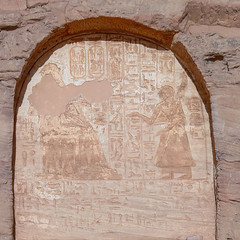
Reliefs from the Exterior Wall of the Great Temple at Abu Simbel

New Kingdom, 19th Dynasty, Reign of Ramesses II (ca. 1279–1213 BCE)
Sandstone
Current location: Abu Simbel, Nubia, Egypt

Lady Harrington Floor Slab - Gayton Northamptonshire

Lady Harrington Floor Slab - Gayton Northamptonshire

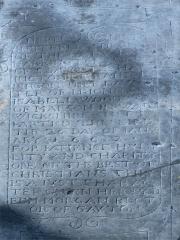
The floor slab to Lady Harrington in St Mary’s Church, Gayton, is a fine example of 17th-century commemorative stonework, combining formal design with a strikingly personal tone. Carved from smooth local limestone, its simple border and restrained scrollwork at either end frame an inscription notable for both its clarity and warmth.

C13 Coffin Lid with Foliated Cross - Gayton Northamptonshire

C13 Coffin Lid with Foliated Cross - Gayton Northamptonshire

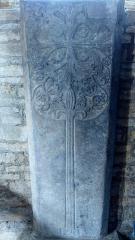
This finely carved coffin lid features a long-stemmed cross whose arms terminate in deeply incised, curling foliage, a design symbolising both the Cross of Christ and the Tree of Life. The leafy ornament, known as a foliated cross, became popular in the 13th century and is often associated with clerical burials or those of prominent parishioners.

Choir stalls Saint-Jean-Baptiste at Montrésor - France

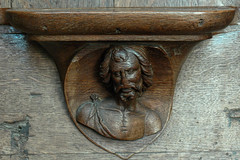
The choir stalls of the collegiate church of Saint-Jean-Baptiste at Montrésor form one of the most eloquent ensembles of Renaissance woodcarving in Touraine. They were made around 1530-1540, when Imbert de Batarnay, seigneur of Montrésor and counsellor to four French kings, endowed the new collegiate foundation he had created in 1521.

Pages

Subscribe to Professor Moriarty RSS