w.208 The Apostles Bartholomew, Matthew, and Simon - Bourges Cathedral
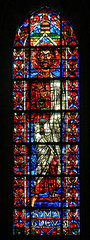
Saint Matthew

Window 208 forms part of the distinguished apostolic cycle that runs around the clerestory of Bourges Cathedral. It presents three standing apostles in individual lancets: St Bartholomew on the left, St Matthew in the centre, and St Simon on the right. Each is set before a deep blue background and surrounded by the richly coloured geometric border characteristic of the Bourges glazing workshop in the early thirteenth century.
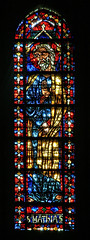
w.212 St Mark, St Luke, and St Matthias - Bourges Cathedral

Window w.212, located high in the south choir clerestory of Bourges Cathedral, dates from c.1210–1215 and belongs to the earliest glazing phase of the High Gothic choir. The window presents two Evangelists, Mark and Luke, and one Apostle, Matthias. 

This trio forms part of a wider apostolic–evangelist cycle distributed around the clerestory, each figure shown as a monumental standing saint set within a richly patterned Gothic frame.

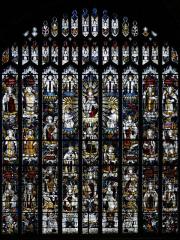
Lichfield Cathedral - South Transept Window

Lichfield Cathedral - South Transept Window

The vast south transept window at Lichfield Cathedral is one of the most imposing works of High Victorian stained glass in the building. Installed between 1869 and 1873 as part of the 19th-century restoration campaign, it was designed and executed by the prolific Gothic Revival studio Clayton & Bell . Comprising nine tall lancets crowned by rich tiers of tracery lights, the window forms a complex yet coherent theological cycle centred on the Majesty of Christ and the ranks of heavenly and ecclesiastical witnesses.

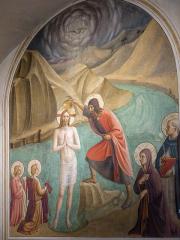
Baptism of Christ (cell 24)

Baptism of Christ (cell 24)

This fresco by Fra Angelico , painted between 1438 and 1443 for the Dominican monastery of San Marco, presents the Baptism of Christ with the clarity, stillness, and devotional intensity characteristic of the artist’s mature period. Set against a serene, winding Jordan River and a stark, mountainous landscape, the composition emphasises the humility of the moment and the contemplative ethos of the monastery for which it was made.

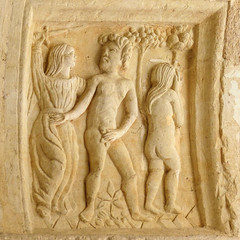
Sacristy Vault Panels - Abbaye Royale de Fontevraud

Adam and Eve

This group of eleven relief panels form part of the carved vault decoration of a sacristy bay at the Royal Abbey of Fontevraud. Executed in a soft, chalky limestone typical of the Loire region, the panels combine biblical narrative scenes with hagiographic episodes from the Life of St Nicholas and include one figure of architectural patronage.

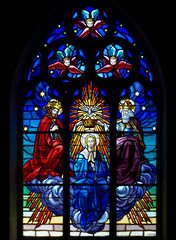
The Stained Glass Cycle at Déols

Coronation of the Virgin

Between 1929 and 1932 the Parisian atelier Mauméjean Frères created a vivid sequence of stained-glass windows for the church of Notre-Dame, Déols. The cycle traces key moments in the lives of the Virgin Mary and Christ, from the Nativity and Annunciation through the Visitation and the miracle at Cana, and finally to the Crucifixion, Resurrection, and the heavenly Coronation of the Virgin.

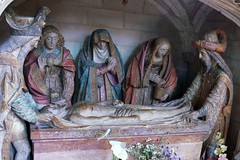
Easter Sepulchre - Neufchâtel-en-Bray, France

Easter SepulchreThis, late 15th–early 16th century, Easter Sepulchre group depicts the moment of Christ’s entombment, a subject traditionally shown in Holy Week rituals in northern France and the Low Countries. The scene is arranged beneath a shallow architectural canopy, gathering together the key figures who, according to the Gospels, prepared Christ’s body for burial.


Coronation and Death of the Virgin - Saint-Maclou, Rouen

Coronation and Death of the Virgin

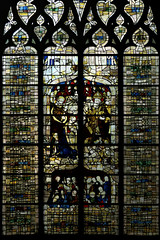
This window (c1470), in the Church of Saint-Maclou, preserves fragments of a mid-15th-century Marian cycle, originally illustrating two principal episodes from the end of the Virgin’s earthly life: the Dormition (Death of the Virgin) in the lower register and the Coronation of the Virgin in heaven in the upper register. Although large sections of the original glazing have been lost, the surviving elements remain representative of the high-quality figure painting produced in Rouen around 1470.

Massacre of the Innocents - St Ouen, Rouen

Massacre of the Innocents

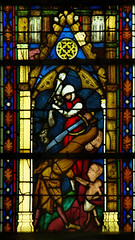
These two stained-glass panels from the choir clerestory of St Ouen form a paired narrative of the Massacre of the Innocents, rendered in the incisive and highly expressive manner characteristic of the early 14th-century Norman workshops. Though each panel stands within its own Gothic architectural frame, complete with gabled canopies, foliate bosses, and alternating bands of strong primary colour, the scenes are conceived as a continuous episode of violent disruption, unfolding across two moments of the same biblical tragedy.

The Life of St Bartholomew – St-Ouen, Rouen

Life of St Batholomew

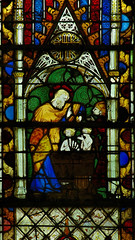
The surviving panels from Baies 12 and 14 of Saint-Ouen in Rouen preserve fragments of a once extensive fourteenth-century cycle devoted to St Bartholomew , one of the Twelve Apostles and the legendary evangeliser of the East. Although the scenes are today divided between two windows and have undergone significant later restoration, they retain the expressive line, saturated colour, and elegant architectural framing characteristic of the Rouen workshops between 1325 and 1339.

Pages

Subscribe to Professor Moriarty RSS