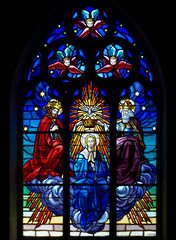
Coronation of the Virgin

Between 1929 and 1932 the Parisian atelier Mauméjean Frères created a vivid sequence of stained-glass windows for the church of Notre-Dame, Déols. The cycle traces key moments in the lives of the Virgin Mary and Christ, from the Nativity and Annunciation through the Visitation and the miracle at Cana, and finally to the Crucifixion, Resurrection, and the heavenly Coronation of the Virgin.
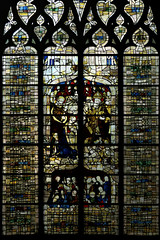
Coronation and Death of the Virgin

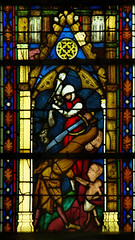
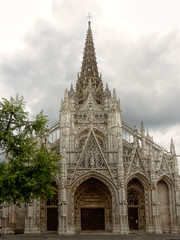
This window (c1470), in the Church of Saint-Maclou, preserves fragments of a mid-15th-century Marian cycle, originally illustrating two principal episodes from the end of the Virgin’s earthly life: the Dormition (Death of the Virgin) in the lower register and the Coronation of the Virgin in heaven in the upper register. Although large sections of the original glazing have been lost, the surviving elements remain representative of the high-quality figure painting produced in Rouen around 1470.

Massacre of the Innocents

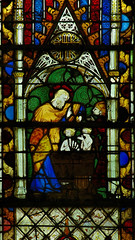
These two stained-glass panels from the choir clerestory of St Ouen form a paired narrative of the Massacre of the Innocents, rendered in the incisive and highly expressive manner characteristic of the early 14th-century Norman workshops. Though each panel stands within its own Gothic architectural frame, complete with gabled canopies, foliate bosses, and alternating bands of strong primary colour, the scenes are conceived as a continuous episode of violent disruption, unfolding across two moments of the same biblical tragedy.

Life of St Batholomew

The surviving panels from Baies 12 and 14 of Saint-Ouen in Rouen preserve fragments of a once extensive fourteenth-century cycle devoted to St Bartholomew, one of the Twelve Apostles and the legendary evangeliser of the East. Although the scenes are today divided between two windows and have undergone significant later restoration, they retain the expressive line, saturated colour, and elegant architectural framing characteristic of the Rouen workshops between 1325 and 1339.

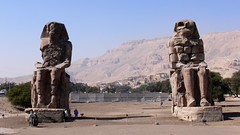
The Colossi of Memnon are two enormous statues that sit on the west bank of the Nile near Luxor, facing east toward the sunrise. Each one shows Pharaoh Amenhotep III seated on a throne, hands resting on his knees, looking out across the river toward the land of the living. They were built around 1350 BCE to stand at the entrance of his mortuary temple, a complex so large it once covered about 35 hectares, bigger than the Temple of Karnak.

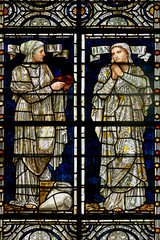
Whitefriars Stained glass by Henry Holiday in  Salisbury Cathedral

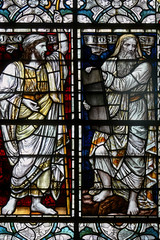
The four stained glass panels designed by Henry Holiday and made by James Powell & Sons (Whitefriars Glass) in 1891 form one of the most refined and spiritually resonant decorative ensembles in Salisbury Cathedral. Conceived as a unified series, they portray eight women of Scripture, Sarah and Hannah, Mary the Virgin and Mary the Mother of James, Mary of Bethany and Mary Magdalene, and Ruth and Esther, each pair chosen to express a distinct yet harmonizing aspect of faith, devotion, and divine purpose.

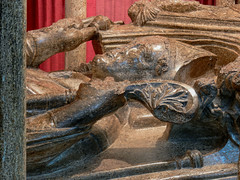
Tomb of Bishop Giles de Bridport

This finely carved effigy represents a 13th-century bishop, shown lying in state with hands raised in prayer. The figure is sculpted from dark Purbeck marble, a material much used in English cathedrals of the period. The bishop is depicted wearing liturgical vestments, including the mitre and chasuble, and rests beneath an elaborately canopied tomb.

Pages

Subscribe to Professor Moriarty RSS