
Deposition from the Cross - Brixworth, Northamptonshire
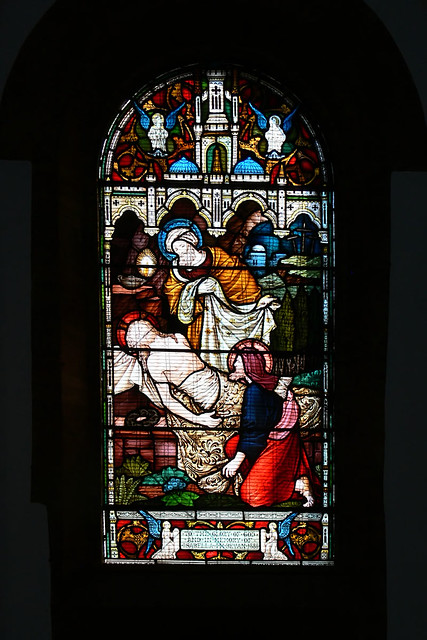
This single-light window depicts the Deposition from the Cross, presenting the moment at which Christ’s body is lowered after the Crucifixion. The scene is composed with a strong sense of physical weight and controlled movement, emphasising both the labour of removal and the solemnity of the act.
Christ’s body is shown inclined and partially supported, his pale flesh forming the visual and emotional centre of the composition. Attending figures bend and reach in coordinated gestures, their overlapping forms creating a dense, inward-focused grouping that conveys shared grief and care. The careful articulation of hands and drapery underscores the tactile reality of the scene, while avoiding excessive dramatic excess.
Behind the figures, a restrained architectural backdrop frames the event, providing visual stability and anchoring the narrative within a Gothic idiom. Colour is used sparingly but effectively: deeper reds and blues in the garments of the attendants contrast with the lighter tones of Christ’s body, guiding the eye through the composition and reinforcing the hierarchy of focus.
The window is characteristic of A. O. Hemming’s late nineteenth-century work, combining clear figural drawing with emotional restraint and narrative clarity. Dated 1889, it belongs to the same moment as his Noli me tangere window, and reflects a consistent approach to biblical subjects in which gesture, balance, and legibility take precedence over theatrical display. The result is a sober and devotional interpretation well suited to parish worship and memorial contexts.
